
Working solo
Can a one-person business offer big-company customer service?
The phone rings in the middle of a job. Answering costs more than the call, and not answering costs the customer. What the research on interruptions, adoption and expectations says about closing that gap.
- 23,6%
- of one-person firms use generative AI
- 21%
- call the next business straight away
- 15%
- productivity gain in a support-desk study
- 87%
- want a human still reachable
The short version
- Interruptions do not just cost their own minutes. Research finds the same work gets done under more pressure, and attention lingers on the task you left.
- One-person firms are the least likely SMEs to use generative AI (23,6%) and the most likely to report benefits once they do.
- The honest business case is recovered enquiries plus protected hours, counted separately, not a notional receptionist salary.
- 87% of customers want a human still reachable. For a solo professional, being approachable is the product.
A self-employed electrician is halfway through an installation when the phone rings.
It is somebody wanting a price for an EV charger. Potentially a good job. Answering means stopping, pulling off the gloves, and trying to talk about one project while standing in the middle of another.
He lets it ring.
Twenty minutes later another customer calls to move an appointment. Then an email arrives asking for an urgent repair. By lunchtime there are three new enquiries waiting and two messages from existing customers.
None of that is unusual. It is what happens when the person doing the work is also the person running the business.
For an independent tradesperson, consultant or cleaner, every hour has two claims on it. Time spent talking to prospects is time not spent on paid work. Time spent on paid work is time when new enquiries go unanswered.
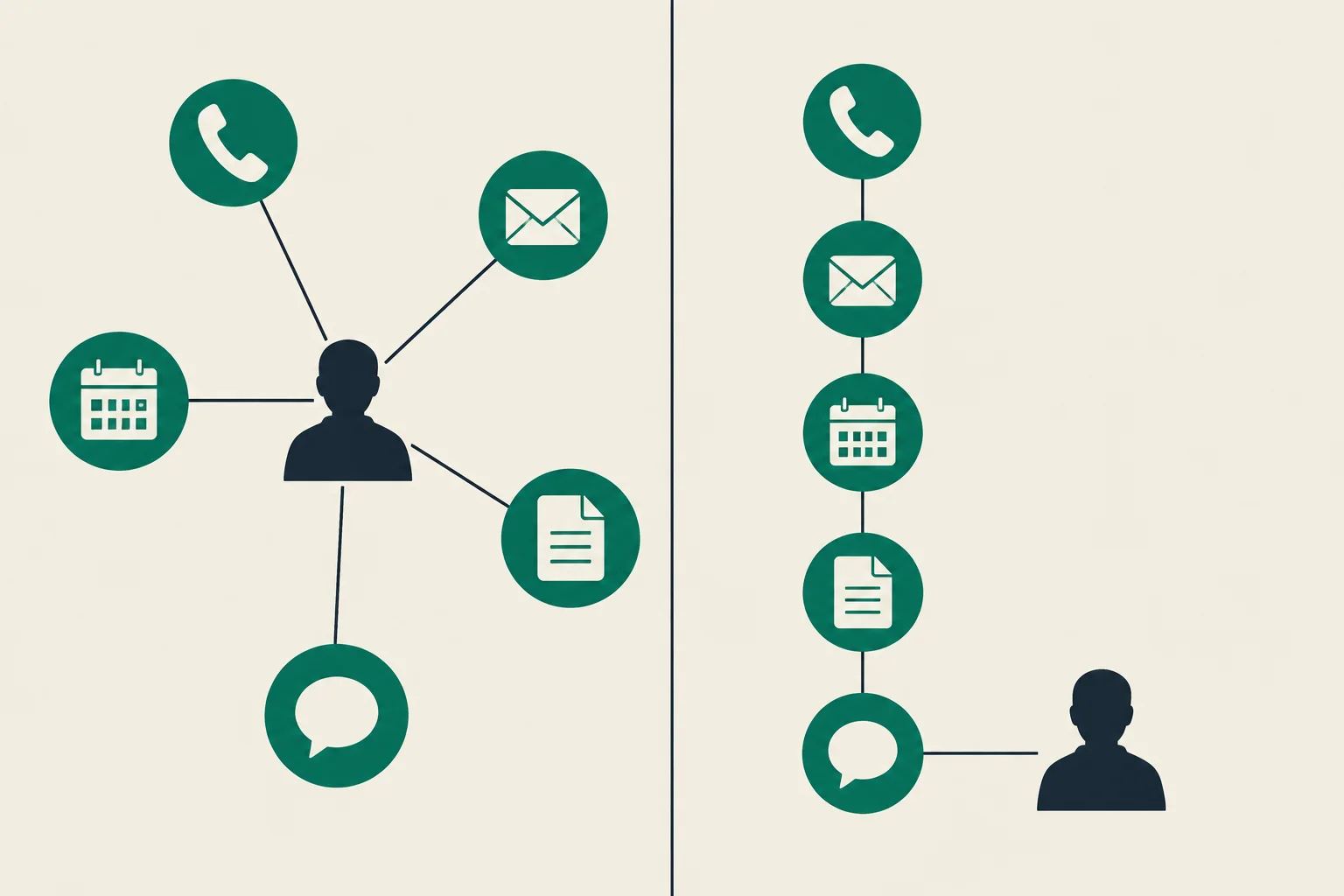
Big companies solve this by splitting the job between people: a receptionist, a service desk, someone in sales, someone in admin. A business of one has no such option.
Customers, meanwhile, do not scale their expectations to the size of the company they are calling. They still want an answer, a next step, a confirmed appointment and to be kept informed.
So can a business of one offer some of what a fifty-person company offers, without losing the thing that makes an independent professional worth hiring?
Largely yes. The economics are just more interesting than swapping a receptionist for software.
The hidden cost of working alone
When people list the disadvantages of being small, they reach for marketing budgets, buying power and competition. The less obvious cost is switching, all day, between doing the work and running the business around it.
An electrician moves between an installation, a phone enquiry and a supplier order. A photographer alternates between editing, scheduling and answering prospects. A consultant breaks off a complex piece of work several times to deal with admin.
Each interruption looks small on its own.

In 2008 Gloria Mark, Daniela Gudith and Ulrich Klocke published The Cost of Interrupted Work: More Speed and Stress at the ACM CHI conference. The result was not the obvious one. Interrupted participants finished their tasks faster, with no measurable drop in quality. They also reported more stress, more frustration, more time pressure and more effort.
So the same work got done, under more pressure.
A second study, by Sophie Leroy in Organizational Behavior and Human Decision Processes in 2009, looked at what happens when you switch between unfinished tasks. Across two experiments she identified attention residue: part of your attention stays on the task you left, which makes it harder to engage fully with the next one.
Neither study tells you how many minutes a tradesperson loses when the phone rings, and neither shows that interruptions always reduce output. Together they explain something every solo professional recognises: a five-minute enquiry is not a five-minute interruption. You stop, take in a new request, make decisions about it, and then have to climb back into what you were doing.
When your income depends on skilled work, protecting uninterrupted time matters as much as working quickly.
Sources: Mark, Gudith and Klocke (2008) and Leroy (2009)
The other half: customers do not wait
Not answering solves one problem and creates another.
You may have excellent reasons to be unavailable. The caller does not know them. From where they are standing there is simply a business that did not pick up.
In September 2025 CallRail published a survey of 1.000 US consumers on what happens when a business is hard to reach by phone. 21% said they would immediately call another business after an unanswered call. 82% said they would call a competitor if a business did not answer, and 78% said they had already taken their business elsewhere after failing to reach someone by phone.
Those are reported intentions, not a measured conversion rate on every missed call, and the survey is American rather than Luxembourgish. The implication for a small service business holds anyway: customers usually have alternatives, and some of them will use those alternatives rather than wait for a callback.
Somebody with a broken boiler rings several heating firms. Somebody looking for a cleaner sends several enquiries. Somebody with a genuine emergency keeps dialling until a human answers.
The firm that answers first is not necessarily the best one. It just gets to start the conversation.
And for a solo business the problem is circular: answering prospects and serving existing customers draw on exactly the same resource, which is the owner's time.
Source: CallRail, Why Businesses Can't Afford to Miss Calls, September 2025
What "big-company customer service" actually means
Service quality and headcount are not the same thing.
A fifty-person company is not automatically more responsive or more helpful. Large organisations have hold queues, internal processes and customers who cannot find the right person. Small businesses often win on exactly those points: you deal with the owner, you take advice from the person doing the work, and nothing gets handed between departments.
What a larger company does have is administrative capacity. It can acknowledge an enquiry while its technical people are busy. It can confirm an appointment without interrupting the person on site. It keeps records, sends reminders and chases what is outstanding.
Matching that does not mean reproducing the structure. It means solving a short list of practical problems.
An enquiry gets acknowledged. The customer's details get written down accurately. Appointments do not get forgotten. Promised callbacks happen. And when something cannot be dealt with now, the customer knows what happens next.
Modest expectations, all of them. They just become hard to meet consistently when every one of them belongs to the same person. That is the part of customer service worth automating.
AI may matter most to the smallest firms
The most interesting number in the OECD's 2025 report Generative AI and the SME Workforce is not the headline.
The study surveyed more than 5.000 SMEs across Austria, Canada, Germany, Ireland, Japan, South Korea and the United Kingdom, and found 31% using generative AI. Adoption split sharply by size: 23,6% of one-person companies, against 45,8% of SMEs with 50 to 249 employees. The smallest firms were about half as likely to have adopted it as the largest within the SME band.
That looks like evidence the technology suits companies with resources. Then look at who reports benefits.
Among firms already using it, one-person companies were the size group most likely to report gains: better performance, new tasks they could now take on, new products or services, higher revenue. Across all sizes, 65% of users reported improved performance and roughly 45% reported cost savings.
These are self-reported benefits. The study did not measure their financial size, and it covers generative AI in general rather than AI receptionists.
The contrast still matters. The businesses least likely to have adopted it are the ones that report the most from it.
There is a plausible reason. In a company of eighty, a productivity gain saves time inside one department. For a sole operator, removing an administrative task changes what fits into the day. The same person answers the email, writes the quote, books the appointment, orders the parts and does the job. Relieve one of those and several others move.
That does not prove every independent professional will benefit. It is a better reason to take the technology seriously than the fact that large corporations are buying it.
Source: OECD, Generative AI and the SME Workforce, November 2025
What a one-person business could actually automate
The useful applications are not the ambitious ones. Nobody needs an AI that runs the company. A few well-drawn processes can absorb the most frequent interruptions.
Taking the enquiries you cannot take
An AI phone assistant answers when the owner cannot, asks what the caller needs and collects the details.
An independent heating engineer gets a call about a boiler. The assistant establishes the address, gets a description of the fault, takes the contact details and the preferred callback time. The engineer gets a summary instead of an unexplained missed call. The caller gets confirmation that their enquiry exists.
It has not diagnosed the boiler or promised a repair. It has done the administrative half of the first conversation, which is the half that does not need the engineer.
Routine appointments
Predictable bookings suit online scheduling already. AI makes that more conversational, which helps when the customer is not sure which service they need or has questions first.
A personal trainer can have an assistant explain the intro session before offering slots. A consultant can let prospects request a discovery call without three rounds of email.
Where the scheduling is connected to a live calendar, the booking can be confirmed automatically, provided the booking rules and the checks are in place. Where it is not connected, the system takes a request. It does not pretend an appointment exists.
Turning a two-line message into a brief
A lot of pre-quote time goes on collecting what the customer did not think to send. "How much to redo a bathroom?" arrives with no measurements, no photos and no description of the work.
An assistant can ask for what is missing, organise it into a brief and open a record for the contractor to review.
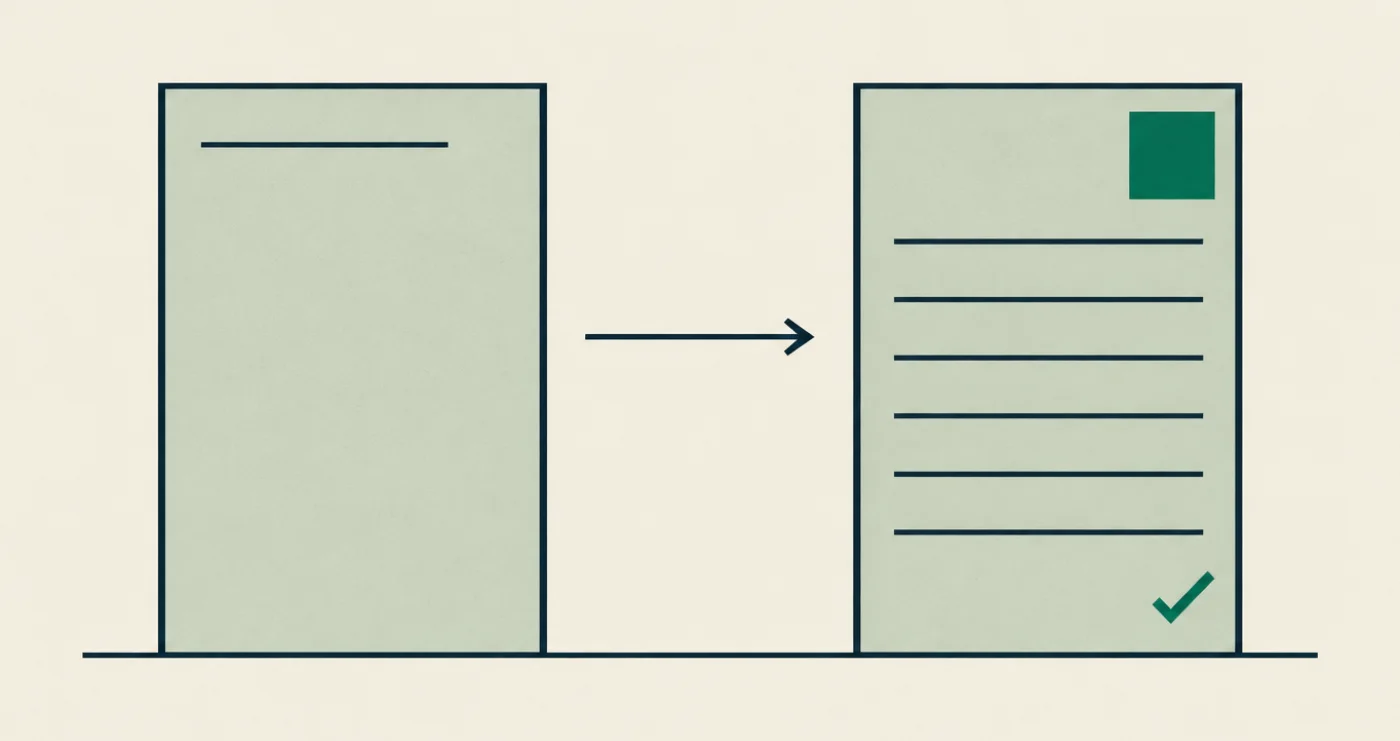
The contractor still decides what the work involves and what it costs. The gain is in starting from a complete enquiry rather than from scratch, every time.
Following up without having to remember
A reminder before an appointment. An update to a customer waiting on a quote. A half-finished booking flagged for attention.
Some of this needs no AI at all. Ordinary scheduling and CRM software has done it reliably for years. AI earns its place where the system has to read an unstructured enquiry, summarise a conversation, or work out which predefined workflow applies.
The goal is not to send more automated messages. It is to stop routine admin depending on the owner remembering it.
Does the research support better service with AI?
There is credible evidence for some of this.
A 2025 study in The Quarterly Journal of Economics followed the rollout of an AI conversational assistant across 5.172 customer-support agents. Erik Brynjolfsson, Danielle Li and Lindsey Raymond found access to AI raised productivity by about 15%, measured as issues resolved per hour. Less experienced and lower-skilled staff gained the most.
That carries weight because it measures work, not opinions about work.
But it studied AI assisting human support staff inside a large organisation. It did not test autonomous AI receptionists, and it says nothing about the economics of a business of one. Nobody should read it as "an independent contractor becomes 15% more productive by installing a phone agent."
What it does establish is that AI can make certain customer-service processes more efficient when it is properly built into the work.
For a sole operator the win is probably not faster phone calls. It is fewer interruptions, better prepared enquiries, and more hours left for the work only they can do.
Source: Brynjolfsson, Li and Raymond, Generative AI at Work, Quarterly Journal of Economics, 2025
The economics: what is an hour of your own time worth?
The business case usually starts by comparing the cost against a receptionist's salary. For a business of one that comparison is wrong, because the owner was never going to hire a receptionist. The question is not what salary you avoid. It is what value you create by recovering enquiries and removing work that does not need you.
Take a hypothetical independent home-services business taking 120 calls a month. Say 25% go unanswered on first ring, because the owner is working, driving or with a customer. That is 30 calls. Say half of those are genuine jobs rather than sales calls, existing customers or something else. Fifteen opportunities.
If an assistant recovers six enquiries that would otherwise have gone nowhere, and a third of those become customers, that is two extra jobs. At 250 € gross profit each after direct costs, 500 €. If the service and its running costs come to 200 € a month, the additional monthly contribution is around 300 €, before setup, tax and anything else.
None of those assumptions is a Luxembourg benchmark. They are there to show the shape of the calculation, and four details decide whether it survives contact with reality.
Not every missed call is a lost customer. Some leave voicemail, some call back, some answer a callback an hour later.
Recovering an enquiry is not winning a job.
Revenue is not profit. A contractor billing 1.000 € may be left with a fraction of it after materials, travel and labour.
And the owner needs the capacity to do the extra work. A business booked solid for three months gains more from better organisation and clearer communication than from more enquiries.
And the hours?
Say an assistant removes three routine interruptions a day at roughly eight minutes each. Over twenty working days that is about eight hours back.
Eight hours saved are not eight billable hours gained. What they are worth depends entirely on what fills them. If they become profitable work, they show up in revenue. If they end the evening admin and get the owner home at a sensible time, that is worth having even though it never appears in the accounts.
Count the two benefits separately, or you will count the same improvement twice.
The honest case rests on additional profit, verifiable efficiencies and the value of protected time. Not on an imaginary salary you were never going to pay.
The limits: judgement is still the job
You can automate parts of customer service without automating the customer.
In August 2026 Gartner published a survey of 3.566 business and consumer customers, conducted in February and March 2026. Half said their interactions are easier when companies use generative AI. And 87% said access to a human agent was essential when a company uses generative AI for support.
That is not a rejection of AI. It is people wanting a way out when automation cannot help them.
For an independent professional the point lands harder than for anyone else, because being approachable, knowledgeable and personally accountable is the competitive advantage. An assistant that handles routine enquiries supports that. One that makes the owner hard to reach destroys it.
The practical limits are the familiar ones. An assistant should not diagnose an electrical fault, promise an emergency response time the business cannot keep, or issue a binding quote for complex work without the right checks. It has to recognise when something needs a person.
Customers should be told they are talking to AI, and the business has to deal with GDPR for personal data, call recordings and transcripts. The EU AI Act's transparency provisions, applying from August 2026, set requirements for certain systems that interact directly with people.
The aim is not to automate the relationship away. It is to stop routine admin eating the time that relationship needs.
Sources: Gartner, August 2026, European Data Protection Board and European Commission
Why this matters in Luxembourg
Luxembourg's local service economy is built on very small firms.
According to the Chambre des Métiers, the craft sector counted 9.935 businesses in 2025, about 81% of them employing fewer than ten people. Those figures do not say how many are one-person operations, but they show where the weight of the economy sits.
In those firms administrative capacity is whatever is left over. A self-employed carpenter handles enquiries, site visits, purchasing, quotes, invoicing and the actual carpentry. A cleaner running their own round spends the day in customers' homes with little chance to answer anything. An independent consultant has the expertise to serve a wide range of clients and no time to run a customer-service operation on top.
Language makes it heavier here. Depending on the business, enquiries come in French, German, English, Luxembourgish or Portuguese. AI tools can collect information across several languages, but each language and its technical vocabulary needs testing before it goes live. A vendor's general multilingual claim does not guarantee a reliable conversation about a heating fault in Luxembourgish.
So the attraction is not lower administrative cost. It is keeping professional, consistent communication while staying small and personally run.
Source: Chambre des Métiers, L'artisanat en chiffres 2025
Technology should make a small business more personal, not less
The worry that AI makes service impersonal is reasonable. Used badly it does exactly that. A customer who hits an automated system that misreads their request, gives them wrong information and will not arrange a callback leaves with a worse opinion of the business than before they called.
The other possibility is real too.
An owner who spends less time collecting phone numbers has more time to talk about the work. A contractor who receives the project details before calling can spend that call discussing solutions instead of asking for measurements. A business that reliably follows up on appointments and open enquiries looks more dependable without hiring anyone.
The point of the automation is not to simulate a bigger organisation. It is to make the small one work properly.
For Fynd.lu, which connects customers with local providers, the same problem exists on both sides of the marketplace. Helping a customer find the right professional is half of it. Helping that professional handle the enquiry is the other half.
Fynd's AI voice agent answers incoming calls, collects the customer's information and sends the business a summary when nobody is available to pick up. That is the limited, practical kind of automation that supports a small business rather than standing in for the professional doing the work. What it returns depends on call volume, reliability, configuration, and whether the captured enquiries turn into anything.
How would you know if it is worth it?
Before buying anything, find out where the admin is actually hurting. That does not need software or a consultant. A few weeks of paying attention will do.
How many enquiries arrive while you are unavailable? How long do you take to respond? How often do you ask for the same information twice? How much of the week goes on arranging appointments and assembling project details?
Then pick one process. An AI assistant for unanswered and after-hours calls only, say, with direct personal contact untouched during the working day.
After a trial, compare against the earlier period: enquiry quality, how many needed a callback anyway, appointment accuracy, admin time, jobs won.
Pay as much attention to what goes wrong. Does it misunderstand people? Are the summaries incomplete? Does it create follow-up work that did not exist before? Are customers comfortable with it?
A system that answers every call and produces unusable enquiries is not helping. Measure the work actually removed from the day and the opportunities actually recovered.
A business of one does not need to become a big company
Being small is usually the appeal. Customers know who they are dealing with. The person who wrote the quote is the person who turns up. Decisions do not pass through three layers.
None of that should be given up as the tools get better. The job is to keep that personal service and add the reliability customers now expect.
The interruption research shows that constant switching has a cost even when the work still gets done. The consumer surveys show that some prospects move on when a business is hard to reach. And the OECD's numbers suggest the smallest firms using AI are the ones reporting the most from it, while remaining the least likely to have tried.
None of which proves an AI agent is the right purchase for every independent professional. Some get few enquiries. Some already have a booking system that works. Some run almost entirely on repeat customers and referrals.
But if your day is repeatedly cut in half between serving customers and fielding requests, it is worth looking at.
Technology cannot produce another skilled professional to do the work.
A business of one does not need a fifty-person service department. It needs a dependable way to look after customers that does not require the owner to be free for every conversation.
Research note: the OECD findings concern generative AI in general rather than autonomous customer-service agents. The interruption studies are experimental and were not run among Luxembourg sole traders. CallRail's survey is US-based. The support-desk productivity study examines a large organisation. The financial scenario is illustrative and is not a measured return for any Luxembourg business.
Research sources
- OECD (2025) — Generative AI and the SME Workforce
- Mark, Gudith and Klocke (2008) — The Cost of Interrupted Work: More Speed and Stress
- Leroy (2009) — Why Is It So Hard to Do My Work? The Challenge of Attention Residue
- CallRail (2025) — Why Businesses Can’t Afford to Miss Calls
- Brynjolfsson, Li and Raymond (2025) — Generative AI at Work, Quarterly Journal of Economics
- Gartner (2026) — Customer service and generative AI survey
- Chambre des Métiers (2025) — L’artisanat en chiffres
- European Data Protection Board — Data protection guide for small businesses
- European Commission (2026) — Transparency obligations under Article 50 of the AI Act