
Heating
Heat pump or new boiler: replacing your heating in Luxembourg this winter
Until 30 June 2027 the state pays 12.000 € towards a heat pump that replaces a fossil boiler, and nothing towards a new gas boiler. What each option costs to buy and to run, and the question about your house that decides it.
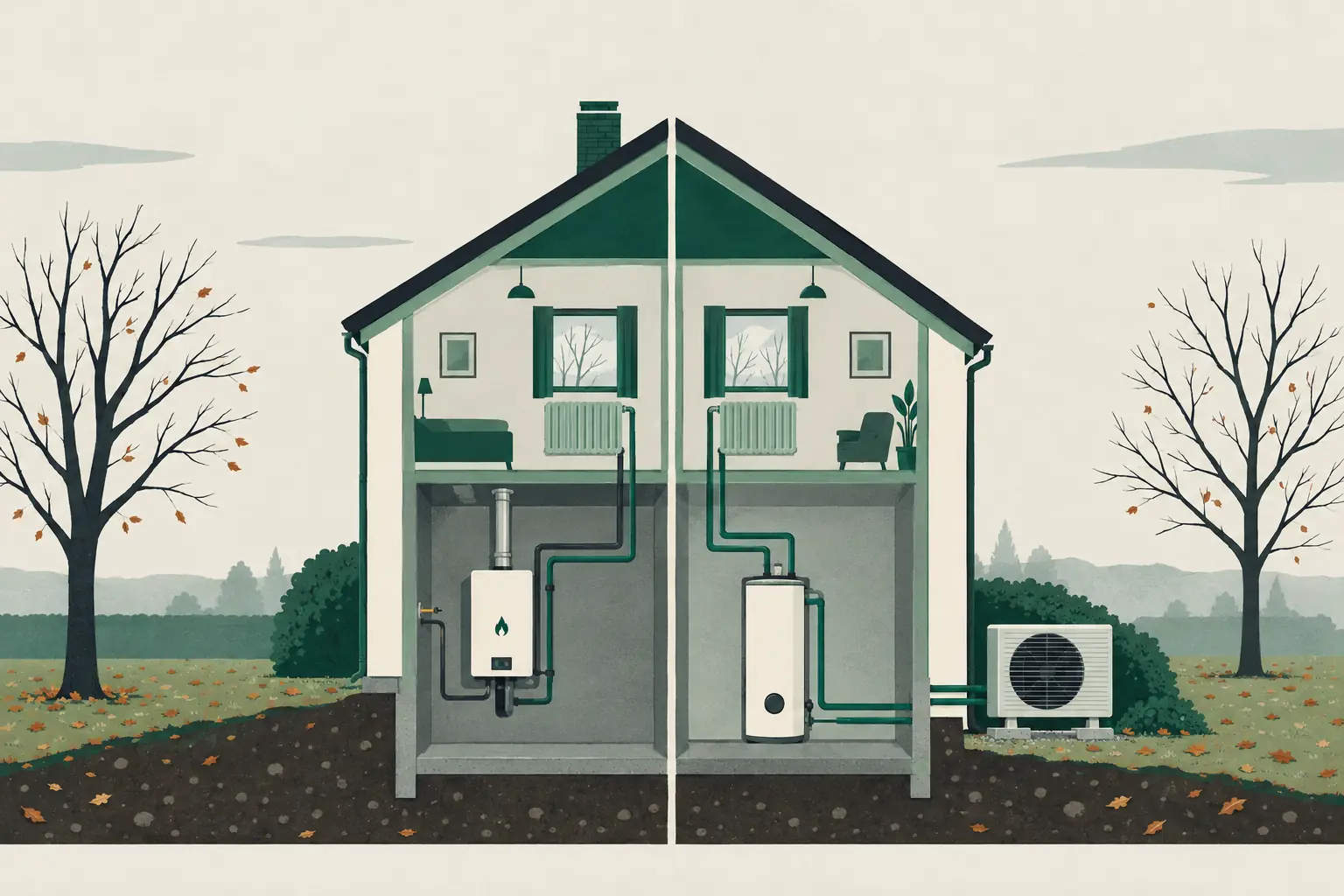
- 12.000 €
- aid for an air-to-water heat pump
- 30 June 2027
- order deadline for the higher amount
- 0 €
- state aid for a new gas boiler
- 17.500 €
- maximum with every bonus
The short version
- No law makes you replace a gas or oil boiler that still works. New homes have been built with heat pumps since 2023.
- An air-to-water heat pump that replaces a fossil boiler in a house gets 12.000 € if you order it by 30 June 2027. A new gas or oil boiler gets nothing.
- After the aid, a heat pump for a typical house costs about the same as a new gas boiler, and less to run as long as it reaches a seasonal efficiency of 2 or more.
- What decides it is your radiators and your flow temperature, not the label on the unit. Get a heat-loss calculation and an itemised quote.
Current as of 27 October 2026.
A house built in 2005, 150 m², heated by the gas boiler that came with it.
At the autumn service the technician finds corrosion on the heat exchanger. The boiler still runs, but it is 21 years old and he would not count on it for another winter. He can fit a new condensing boiler next week.
The owner asks for a second quote, for an air-to-water heat pump. It comes back at 19.000 €, against 9.000 € for the boiler.
On those two numbers the boiler wins easily. They are the wrong two numbers.
Until 30 June 2027, Luxembourg pays 12.000 € towards an air-to-water heat pump that replaces a fossil boiler in a house, and nothing towards a new gas boiler. For a typical house that puts the two options at about the same price, and the heat pump costs less to run. Whether it is right for your house depends on your radiators, not on the subsidy.
What the rules actually say
Start with what is not true. No Luxembourg law obliges you to rip out a gas or oil boiler that still works.
New homes are a different matter. Since 1 January 2023, the energy performance rules for new residential buildings use a heat pump as the reference system, which in practice ends fossil heating in new construction. For existing buildings, the national energy and climate plan takes a voluntary approach: the state pays you to switch when the old system fails, it does not force you to.
So if your boiler dies this winter, a new gas boiler is still a legal choice. It is simply the one the state no longer helps with.
Sources: IEA, Luxembourg’s energy and climate plan on fossil boilers
What the state pays in 2026
The Klimabonus Wunnen scheme was renewed in July 2026 for 2026 to 2030, backdated to 1 January 2026. Heat pump aid is now a flat amount, whatever the size of the unit.
| Heat pump, existing home | Replaces a fossil or electric heater | Without a replacement |
|---|---|---|
| Air-to-water, house | 12.000 € | 8.000 € |
| Ground-source, house | 14.000 € | 10.000 € |
| Air-to-water, per flat | 10.000 € | 5.000 € |
| Ground-source, per flat | 12.000 € | 7.000 € |
These are the higher amounts agreed in the June 2026 tripartite. They apply when the heat pump is ordered between 1 January 2026 and 30 June 2027 and invoiced by 31 December 2028. After that the base amounts are 2.000 € lower: 10.000 € for an air-to-water heat pump in a house, 12.000 € for ground-source. Apartment buildings are capped at 30.000 € per building for air-to-water and 60.000 € for ground-source.
Three bonuses sit on top.
Adapting your heating system: 50% of the cost of changing radiators or pipework, up to 2.000 € in a house and 5.000 € in an apartment building.
Removing an oil tank: 1.500 €, when you replace an oil boiler and a specialised company removes, neutralises and recycles the tank.
Drinking-water protection zone: 2.000 € more for replacing an oil boiler located in one.
The government’s own example adds it all up: an air-to-water heat pump replacing an oil boiler in a house, with radiator work, tank removal and a protection zone, comes to 17.500 €.
Two older conditions have gone. The boiler you replace no longer has to be at least ten years old. And “hybrid” systems that pair a heat pump with a gas or oil boiler are no longer funded. A hybrid only qualifies if both halves are non-fossil.
Sources: Guichet.lu, Klimabonus 2026 heat pump aid and the government’s presentation of the scheme
The upfront cost, side by side
Few Luxembourg heating firms publish prices. One that does is Wagner & Freymuth in Roedt, which in October 2026 advertised two installed packages:
- an air-to-water heat pump at a regular price of 19.500 €, including the heating adjustment, hydraulic balancing and commissioning, advertised from 11.000 € after the grant;
- a gas condensing boiler from 13.500 € on promotion (regular price 17.500 €), including removal of the old system, new pipework, chimney renovation and the gas connection.
A gas boiler gets no aid, so its price is what you pay. A heat pump’s price falls by the aid that applies: 12.000 € for an air-to-water unit replacing a fossil boiler, if you order it by 30 June 2027.
These are one firm’s package prices. A plain boiler swap with no chimney or pipework will cost less than that package, and a heat pump for a large or poorly insulated house will cost more. Quotes for the same kind of system also vary widely. When a German consumer centre checked 160 air-to-water heat pump offers in July 2026, totals ran from 21.099 € to 54.168 €, with an average of about 36.400 €. That is a German figure, not a Luxembourg price, but it shows why a quote for your own house matters more than any average. Fynd’s heating cost guide sets out what is published for Luxembourg.
Two things change the cash picture.
The aid comes after you pay. You settle the installer in full and apply afterwards, so you need the whole 19.000 € up front. From 1 January 2027 there is an alternative: installers registered with the state can deduct the aid straight from the final invoice and claim it themselves. The amount is the same either way.
VAT. Renovation work on a home used as a main residence is taxed at the super-reduced 3% rather than 17%, within a limit of 50.000 € of VAT advantage per home. On a 19.000 € job that is a difference of more than 2.500 €, so make sure your installer applies it.
Sources: Wagner & Freymuth, heating packages, Verbraucherzentrale Rheinland-Pfalz, July 2026 and TVA logement brochure
The running cost
This is where the heat pump earns back what it costs, and where it can disappoint.
A boiler turns one unit of gas into slightly less than one unit of heat. A heat pump moves heat from the outside air, so one unit of electricity gives you several units of heat. Over a whole year that ratio is the seasonal coefficient of performance, or SCOP. A SCOP of 3 means 3 kWh of heat for every 1 kWh of electricity.
Electricity costs more per kWh than gas. In 2026 Luxembourg households paid roughly 20 c/kWh for electricity all-in and roughly 9 c/kWh for gas. So the heat pump has to be efficient enough to beat a price more than twice as high.
- Gas condensing boiler1.800 €
- Heat pump, SCOP 2,51.440 €
- Heat pump, SCOP 3,01.200 €
- Heat pump, SCOP 3,51.030 €
Fynd calculation. Gas at about 9 c/kWh all-in with a 90% efficient condensing boiler; electricity at about 20 c/kWh all-in. Heat pump shown at three seasonal efficiencies (SCOP). Before the temporary August–December 2026 subsidies.
Take the 150 m² house and assume it needs about 18.000 kWh of heat a year. A 90% efficient condensing boiler burns about 20.000 kWh of gas for that, around 1.800 €. A heat pump at a SCOP of 3 uses 6.000 kWh of electricity, around 1.200 €.
At these prices the two break even at a SCOP of about 2. Below that the boiler is cheaper to run. A well-installed air-to-water heat pump in a reasonably insulated house usually does better than 3. A badly sized one, pushing hot water through radiators that are too small, can fall towards 2,5 or lower.
If the heat pump also takes over your hot water and you cancel gas entirely, you stop paying the gas network’s fixed access charge as well, about 100 € a year.
The temporary help on this winter’s bills does not change the comparison much. From 1 August to 31 December 2026 the state takes 4 cents off every kWh of electricity for households using under 25.000 kWh a year, and 15 cents off every cubic metre of gas, which is about 1,4 c/kWh. Both end on 31 December 2026.
Sources: Luxembourg Government, gas and electricity subsidies, July 2026 and Switchr, 2026 household tariffs
The question that decides it: your radiators
A heat pump is most efficient when it heats water to a low temperature. A gas boiler typically sends water to the radiators at 60 to 70°C. A heat pump is at its best around 35 to 45°C, and gets less efficient the hotter it has to go.
So the real question is whether your house stays warm with cooler radiators.
Underfloor heating is ideal. Large radiators in a house with reasonable insulation usually work. Small radiators in a draughty house often do not, and that is where you either change a few radiators, insulate first, or accept a lower SCOP.
There is a simple test you can run this winter with the boiler you have. On a cold day, turn the boiler’s flow temperature down to 50°C and leave it for a few days. If every room still reaches a comfortable temperature, your radiators are probably fine for a heat pump. If one or two rooms stay cold, those are the radiators to replace, and the Klimabonus pays half of that work up to 2.000 €.
The scheme itself pushes in this direction. It requires the heating network to be hydraulically balanced, and if your system cannot run at 35°C the heat pump has to meet the efficiency threshold at the temperature it will actually use.
When a new gas boiler is still the sensible call
The heat pump is not the right answer everywhere.
You live in a flat with no place for the outdoor unit. In a building held in co-ownership, putting a unit on a façade, balcony or roof usually needs the co-owners’ agreement. A building-wide system is often the better route, and the aid is paid per flat.
There is nowhere quiet enough for it. An air-to-water unit has to stay under sound power limits of 48 to 55 dB(A) depending on its size, or under 40 dB(A) at the nearest buildable plot boundary. The installer has to check this with the official noise calculator before installing. On a tight terraced plot, that can rule out the obvious spots.
The boiler fails in January and you need heat this week. A heat pump needs a heat-loss calculation, an order and an installation slot. A temporary repair or a rented heating unit may buy time for a proper decision. A new gas boiler fitted in a hurry is the heating you will live with for the next fifteen years or more.
A deep renovation is coming. If you plan to insulate the roof and walls in the next couple of years, the house will need a much smaller heat pump afterwards. Sizing it for today’s heat loss means paying for capacity you will not use. Heat pumps installed together with an energy renovation can be invoiced until 2035, but the extra 2.000 € only applies to orders placed by 30 June 2027. Weigh the two.
How to do it, in order
1. Get free advice first
Klima-Agence gives free, independent basic advice at home, by video or by phone on 8002 11 90, and its simulator at aides.klima-agence.lu estimates which aid a project qualifies for.
2. Ask for a heat-loss calculation
The heat pump should be sized for your house, not matched to the output of the old boiler, which is often oversized. Fynd lists heat pump installers in Luxembourg.
3. Compare itemised quotes
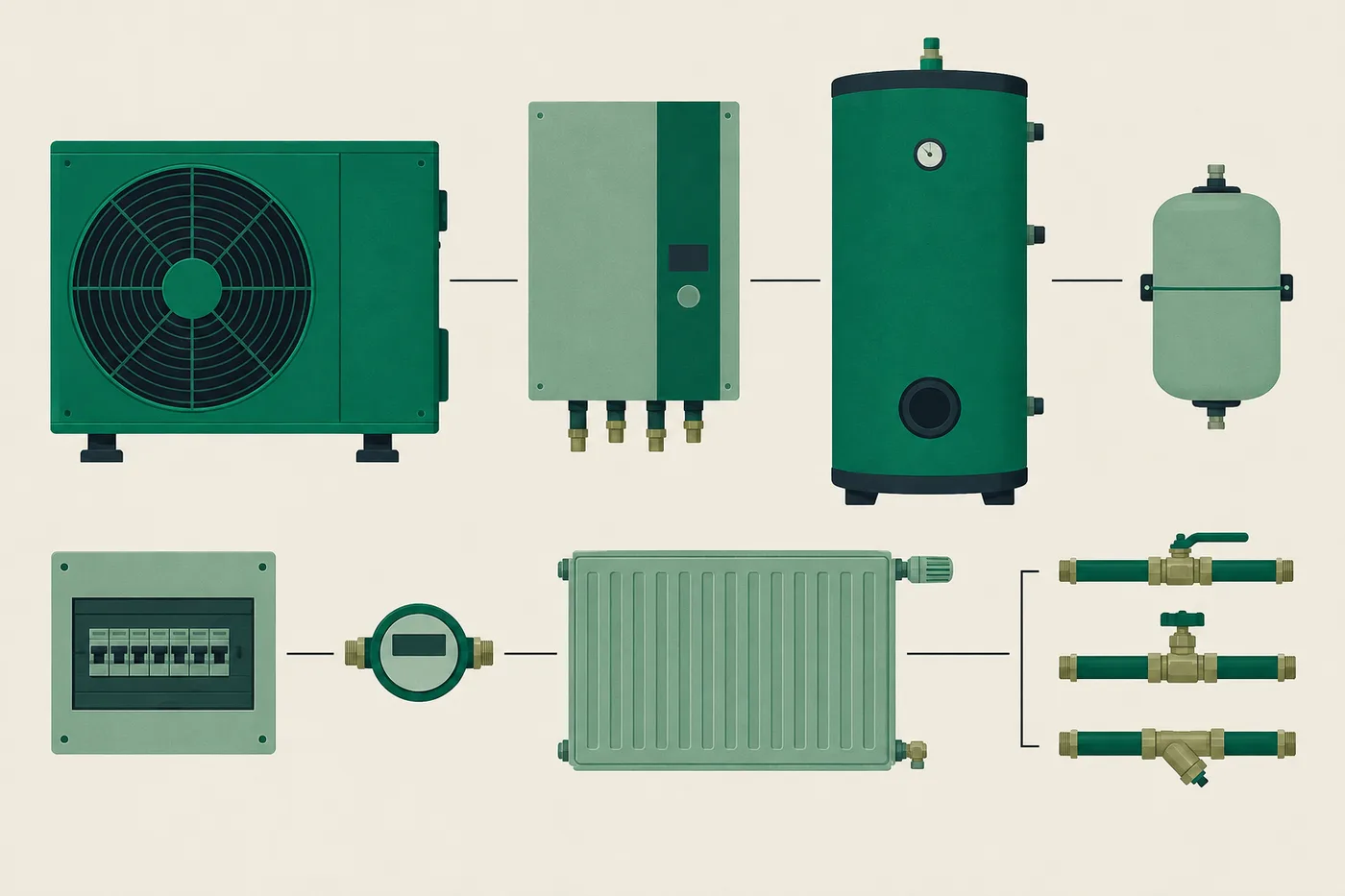
A full quote covers the outdoor unit and indoor module, the hot-water cylinder, any buffer tank, the dedicated electrical supply, the electricity and heat meters the aid requires, hydraulic balancing, removal of the old boiler and, for oil, the tank. In the German check of 160 offers, about 90% did not mention the metering at all, and only about a third clearly included the work on the meter cabinet. Ask for both in writing.
4. Order before 30 June 2027, in writing
The higher aid depends on the order date, and the dated order is one of the documents you will need.
5. Installation and inspection
Since 19 September 2025, every heat pump has to be inspected by the Chambre des Métiers. The installer must request the inspection within a month of commissioning, and you need proof of that request for the aid.
6. Apply for the aid
After installation, through MyGuichet.lu with LuxTrust or an eID, or on paper with form DEPA-2026. Attach the paid invoices and proof of payment, the technical sheet POCH-2026 and certificate CCPOCH-2026 from the installer, the dated order and the inspection request. You have until four years after the end of the year of the invoice. From 2027 you can ask a registered installer to handle the prefinancing instead.
To compare installers and their availability in your area, see heat pump companies in Luxembourg.
Source: Guichet.lu, Klimabonus 2026 heat pump aid
So which is it?
For the house in the opening example, built in 2005 and reasonably insulated, the numbers are clear. The heat pump costs 19.000 €, the state returns 12.000 €, and the 7.000 € left is less than the 9.000 € boiler quote. It then saves several hundred euros a year on energy, as long as it is sized properly and the radiators can work at lower temperatures.
For an old, draughty house with small radiators, the heat pump is still possible, but it costs more and the savings depend on getting the system right. That is a reason to get a proper survey, not a reason to default to gas.
The deadline is what makes this winter different. The extra 2.000 € depends on the order date, and that window closes on 30 June 2027.
Legal note: this reflects the official sources available on 27 October 2026. Aid amounts and conditions are those of the Klimabonus Wunnen scheme as presented on Guichet.lu; the law prevails where a summary differs. Energy prices vary by supplier and contract, so run the comparison with your own tariffs. Confirm eligibility with Klima-Agence or the Guichet unique des aides au logement (8002 10 10) before ordering.
Sources
- Guichet.lu — Klimabonus 2026: aid for technical installations (heat pumps)
- Luxembourg Government — “Klimabonus Wunnen” 2026-2030, 16 July 2026
- Ministry of the Environment — Klimabonus Wunnen 2026-2030 presentation (PDF), 16 July 2026
- Luxembourg Government — Gas and electricity price subsidies from 1 August 2026, 14 July 2026
- IEA — Luxembourg’s National Energy and Climate Plan: fossil fuel boilers
- Administration de l’enregistrement — TVA logement brochure, 2025 (PDF)
- Wagner & Freymuth — Published heating package prices, October 2026
- Verbraucherzentrale Rheinland-Pfalz — 160 heat pump offers checked, 2 July 2026
- Switchr — Household gas and electricity tariffs in Luxembourg, 2026
- Klima-Agence — Free advice and the aid simulator