
AI voice agent
The hidden cost of missed calls: how AI receptionists help small businesses stop losing customers
Every unanswered phone call could be a missed opportunity. New research shows how often calls go unanswered, why customers turn to competitors, and what AI phone agents can realistically do.
- 82%
- would call a competitor instead
- 56%
- of calls reach a person
- 79%
- switch for a faster response
- 70%
- of eligible AI costs funded
The short version
- 82% of US consumers surveyed say they would call a competitor when a business does not pick up.
- Across 70 million calls, only 56% reached a person. In home services it was 52%.
- Luxembourg SMEs can get 70% of an eligible AI project funded through SME Packages – AI.
- Measure your own missed calls before buying anything: when they arrive, and what they were about.
Imagine this.
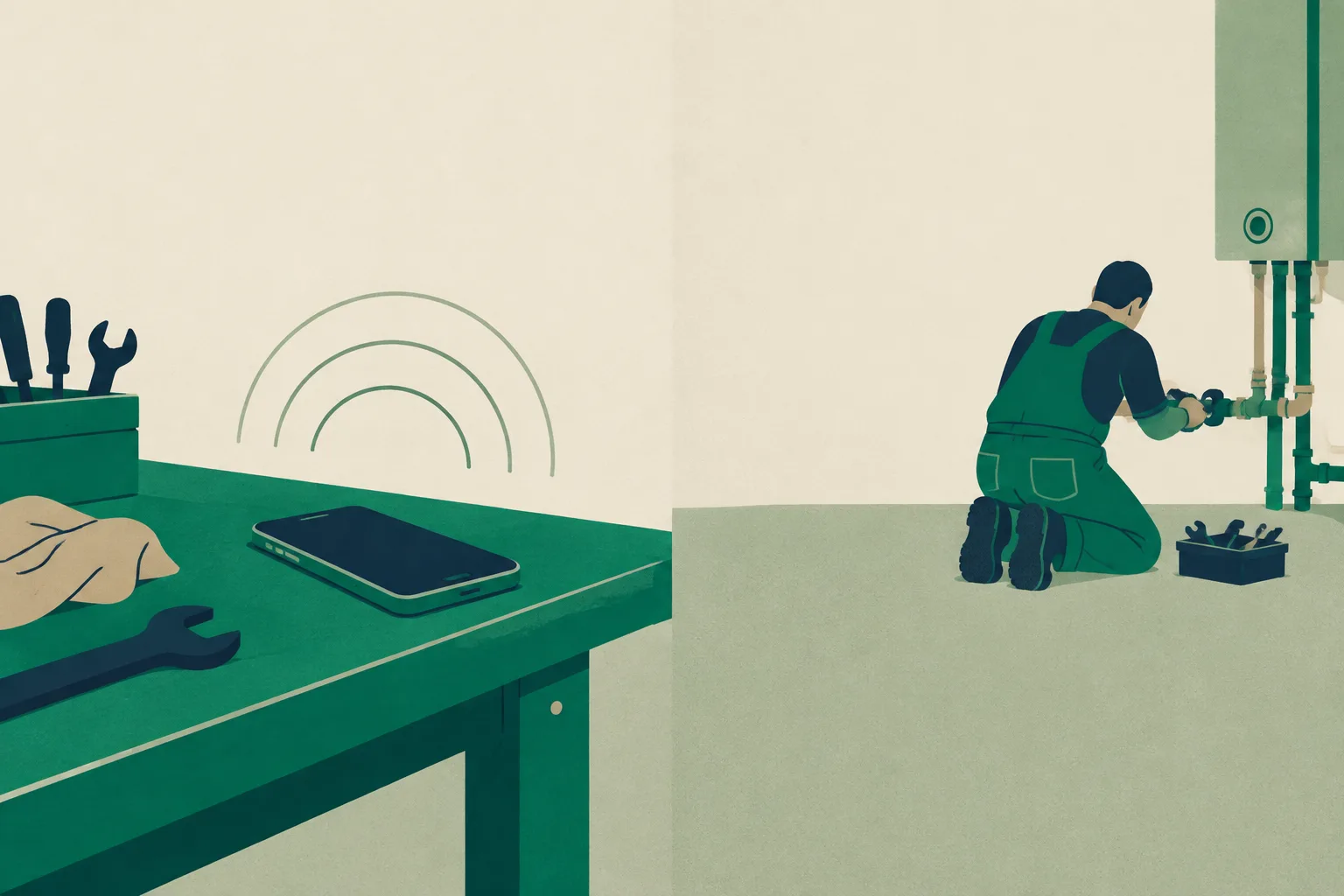
A potential customer searches Google for a plumber. They find your business, read your reviews, and decide to call.
The phone rings.
But you're busy with another customer, working on a job, or simply closed for the evening.
Nobody answers.
So the customer calls the next business on Google.
That business picks up, books the appointment, and wins the job.
You didn't lose the customer because your service was worse or your prices were too high. You may have lost them simply because you weren't available when they needed you.
For small and medium-sized businesses (SMEs), this is an everyday problem. And research suggests its consequences can be serious.
Fortunately, advances in AI voice technology are making it possible for businesses to answer inquiries around the clock, without hiring additional reception staff.
The Research: What Really Happens When a Business Doesn't Answer?
For years, business owners have assumed that customers who couldn't get through would leave a voicemail or try again later.
But that assumption doesn't always hold up.
In September 2025, CallRail published research based on a survey of 1.000 US consumers investigating what happens when businesses fail to answer their phones.
The findings were striking:
- 82% said they would call a competitor if a business didn't answer.
- 78% reported having taken their business elsewhere after failing to reach a company by phone.
- 21% said they would immediately call another business following an unanswered call.
- 41% said they would hang up after just one to two minutes on hold.
These figures highlight an important reality: many customers are not willing to wait.
The numbers measure consumers' reported experiences and intentions, not the proportion of every missed call that results in a lost sale. Nevertheless, they demonstrate a genuine competitive risk for businesses that are difficult to reach.
Consider a homeowner dealing with a leaking pipe. They probably aren't interested in leaving three voicemails and comparing responses tomorrow.
They need someone who can help now.
When that first business doesn't answer, the next available provider has an opportunity to win the work.
In many situations, availability is part of the buying decision.
Source: CallRail — Why Businesses Can't Afford to Miss Calls (2025)
The Problem Is Bigger Than You Might Think
How often do businesses actually fail to connect callers with a person?
In July 2026, Invoca published its Lead Conversion Benchmarks Report, analyzing more than 70 million phone calls and 600 million minutes of conversation across ten industries.
The report found that only 56% of inbound calls reached a person.
The rate varied by industry, and home services was among the lowest:
- Home services52%
- Healthcare54%
- Business services56%
- Automotive58%
- Consumer services60%
- Travel64%
Invoca, Lead Conversion Benchmarks Report 2026 (70m+ calls, ten industries).
These figures come from Invoca's customer base and include calls of varying lengths. Calls not answered by a person aren't necessarily lost: some may have been handled by automated systems or voicemail.
Still, the research points to a significant gap between customers trying to contact businesses and businesses being available to speak with them.
For SMEs, the challenge is easy to understand.
A hairdresser cannot answer the phone while cutting someone's hair. A dental receptionist may already be helping a patient. A tradesperson may be working in an environment where picking up is impractical.
Meanwhile, potential customers continue to call.
Source: Invoca — Lead Conversion Benchmarks Report 2026
Why Missed Calls Can Cost More Than Just One Sale
The financial impact of an unanswered phone call isn't always obvious.
But consider what happens before that call.
Your business may have spent money on Google Ads, invested in search engine optimization, built a website, collected positive reviews, or paid for local advertising.
All of that effort helped convince somebody to contact you.
Then, at the moment they were ready to take the next step, nobody was available.
This creates three potential costs.
1. Lost revenue
Some unanswered calls are genuine buying opportunities.
A customer might be ready to schedule a consultation, book a treatment, request a repair, or purchase a service.
If they move on to another provider, the potential revenue disappears with them.
2. Wasted marketing investment
Businesses can spend substantial amounts attracting leads while paying less attention to what happens when those leads call.
A successful advertisement may generate plenty of phone inquiries. Yet if those inquiries aren't answered or followed up, the campaign can deliver disappointing commercial results despite attracting interested customers.
3. Lost long-term customer value
Some customers are worth considerably more than their first purchase.
A new dental patient may return for years. A satisfied homeowner might recommend an electrician to friends and family. A business client may become a recurring customer.
Losing the initial conversation can mean missing these future opportunities, too.
Why Speed Has Become a Competitive Advantage
Today's customers are accustomed to immediate access to information.
They can book hotels online, order food in seconds, and receive customer support without waiting until the next business day.
Increasingly, they bring those expectations to smaller service businesses.
Invoca's 2026 B2C Buyer Experience Report surveyed 693 US consumers who had researched and made significant purchases.
It found that 79% said they would switch to a competitor that responds faster.
This doesn't mean that speed matters more than everything else. Expertise, trust, quality, and pricing remain important.
But when customers are comparing several similar businesses, responsiveness can influence who gets the opportunity to earn their trust.
For a small business, that creates a simple question:
How can you be available whenever a potential customer calls, without being personally available 24 hours a day?
This is where AI phone agents are beginning to make a difference.
Source: Invoca — B2C Buyer Experience Report 2026
What Is an AI Phone Agent?
An AI phone agent, sometimes called an AI receptionist or AI voice assistant, is software that can answer telephone calls and hold spoken conversations with customers.
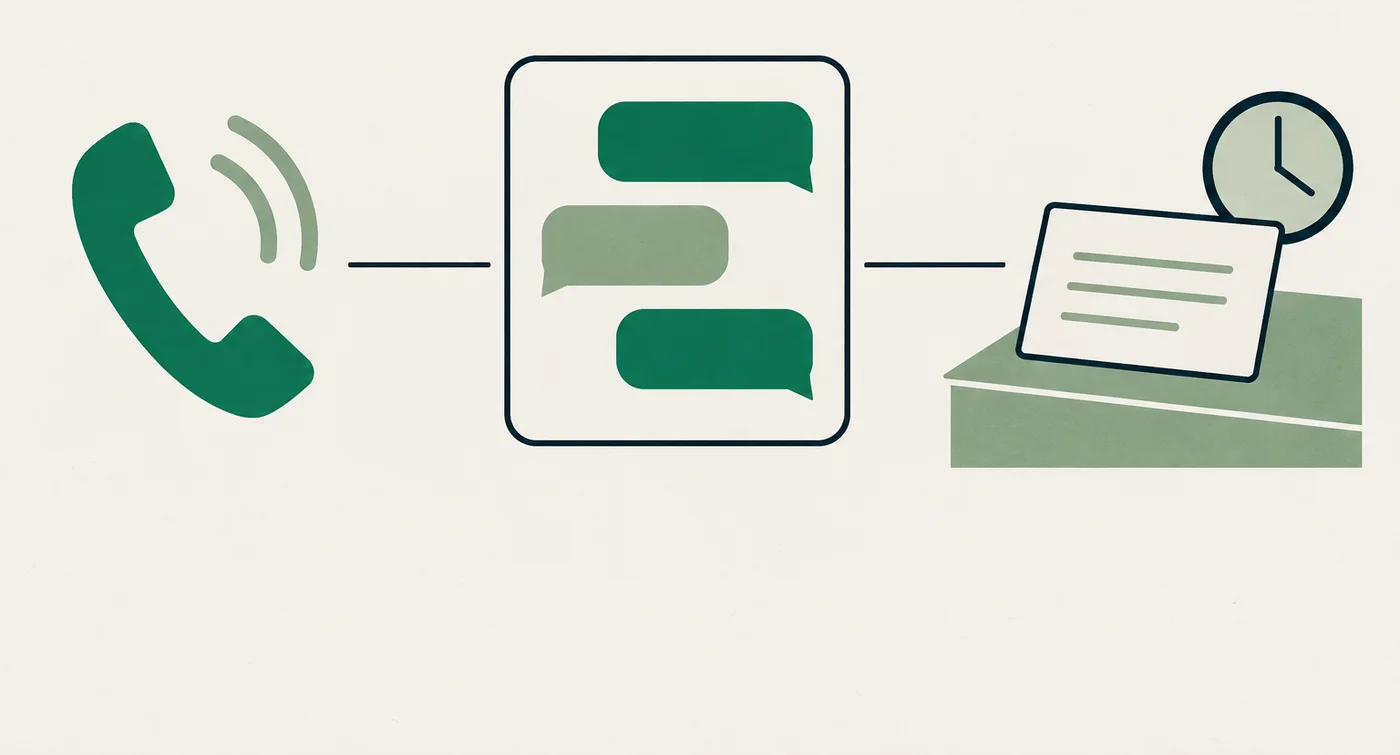
Unlike traditional voicemail systems, modern AI voice agents can understand many everyday questions, respond conversationally, collect information, and perform certain tasks.
Depending on the system and its integrations, an AI receptionist can:
- Answer incoming calls outside normal business hours.
- Respond to questions about services, prices, and availability.
- Collect the caller's name, contact details, and reason for calling.
- Book appointments directly into a connected calendar.
- Qualify new inquiries before forwarding them to the business.
- Transfer urgent or complicated requests to a human.
- Provide summaries so the business owner can follow up efficiently.
For example, imagine a dental practice receiving a call at 8:30 p.m.
Instead of hearing an unanswered ring or voicemail greeting, the caller reaches an AI assistant that can explain appointment options, collect the necessary information, and potentially schedule a visit.
The practice hasn't hired another employee to work evenings.
But the customer has received an immediate response.
That's the central opportunity: AI doesn't have to replace a receptionist to create value. It can cover the hours and situations when people aren't available.
Are Customers Actually Comfortable Talking to AI?
One concern is whether customers want to interact with an AI assistant.
The evidence suggests the answer depends on the task.
In CallRail's 2025 survey:
- 52% of consumers believed businesses offering AI assistance after hours provided superior service.
- 50% said they would use AI to book an appointment.
- 66% said they would use AI to check business hours or locations.
These findings indicate that many customers are open to AI when it solves a straightforward problem.
However, that doesn't mean every customer wants every conversation automated.
Sensitive situations, complaints, emergencies, and complex purchasing decisions may still require empathy and human judgment.
The most promising approach for many SMEs is therefore a combination of AI availability and human support.
Let the AI answer routine inquiries, capture leads, and handle simple bookings.
Let people take over when their expertise is needed.
The goal should not be to automate every conversation. It should be to ensure customers can get useful assistance when they call.
How Much Revenue Could an AI Receptionist Recover?
Let's consider a hypothetical small service business.
Suppose it receives 200 calls per month.
Of those, 25% go unanswered because employees are busy or the business is closed.
That's 50 missed calls.
Now assume:
- 40% of those missed calls represent genuine potential customers.
- An AI receptionist helps recover 60% of those qualified opportunities that would otherwise have been lost.
- 30% of the recovered opportunities become paying customers.
- Each new customer generates 250 € in gross profit.
Under these assumptions, the business gains approximately 3,6 additional customers per month, generating 900 € in additional gross profit.
If the AI receptionist costs 300 € per month, that leaves an illustrative net benefit of 600 € monthly, before other setup and operating expenses.
Over a year, that's 7.200 €.
Of course, these are example figures, not guaranteed outcomes.
Actual performance depends on the industry, call quality, customer behavior, agent performance, and how many leads would otherwise have been recovered through existing follow-up processes.
But the calculation illustrates why phone availability can matter financially.
For some businesses, a handful of additional bookings each month could cover the cost of an AI receptionist.
Which Small Businesses Could Benefit Most?
AI receptionists may be especially useful for businesses where phone inquiries are valuable but staff cannot consistently answer them.
Trades and home services: Plumbers, electricians, HVAC companies, cleaners, and repair businesses often receive calls while employees are working on-site. Customers may contact multiple providers, especially for urgent problems.
Healthcare and dental practices: Reception teams frequently manage patients, scheduling, and administrative work simultaneously. AI can help collect routine appointment requests and reduce unnecessary interruptions, subject to appropriate privacy safeguards.
Salons and beauty businesses: Staff may be unable to answer during treatments, making automated appointment handling and after-hours availability useful.
Professional services: Accounting firms, consultants, and other service providers can use AI to gather new-client information and arrange consultations.
Hospitality and restaurants: AI can potentially handle reservation inquiries, opening-hour questions, and other frequent requests during busy service periods.
The common factor isn't the industry itself.
It's the combination of valuable inbound calls, limited staff availability, and customers who expect timely answers.
What Does This Look Like for a Business in Luxembourg?
Take a hypothetical example: a small electrical contractor in Esch-sur-Alzette who spends much of the working day on customer sites.
If a homeowner calls about an electrical fault while the contractor is working, there's a good chance the call will have to wait. An AI receptionist could collect the caller's location, contact details, and description of the problem, then forward the inquiry for assessment once the contractor is available.
In Luxembourg, there's another practical consideration: language. Depending on the business, customers may expect to communicate in French, Luxembourgish, German, English, or Portuguese. A properly configured multilingual AI agent could help businesses handle more of those inquiries, although the quality of each supported language needs to be tested.
There is also evidence that Luxembourg SMEs are investing in digitalisation.
According to the Ministry of the Economy, 533 applications were approved under the SME Packages Digital, AI and Cybersecurity programmes in 2025, representing 5,2 million € in financial support. That's up from 382 approved applications in 2024.
These figures don't tell us how many Luxembourg businesses use AI receptionists, or how much revenue they're recovering from missed calls. But they do show that local businesses are investing in technology to improve how they operate.
Source: Luxembourg Ministry of the Economy — 2025 State Aid Review (May 2026)
Luxembourg's SME Packages – AI: 70% Support for Eligible Projects
For Luxembourg SMEs considering AI, the initial cost of implementation may also be lower than expected.
The Luxembourg government introduced SME Packages – AI in March 2025 to help small and medium-sized businesses adopt practical AI solutions.
Under the programme, the Ministry of the Economy provides financial support covering 70% of eligible implementation costs, for approved projects costing between 3.000 € and 25.000 € excluding VAT.
For example, a qualifying 6.000 € project could receive 4.200 € in government support, leaving the business to contribute 1.800 €.
An AI receptionist project that involves configuration, integration with existing systems, or automation of customer inquiries may be worth exploring under the programme. However, eligibility depends on the proposed solution and the Ministry's approval. Businesses should not assume that standalone subscriptions or ongoing operating costs are automatically covered.
The process begins with a preliminary assessment through the House of Entrepreneurship, or eHandwierk for craft businesses, before the application is submitted for approval. The grant is paid after the approved project has been implemented and the provider paid.
For an SME already considering AI, it's an opportunity worth investigating before making the investment.
Source: Guichet.lu — SME Packages – AI
AI Receptionists Are Not a Magic Solution
Despite their potential, AI agents are not automatically better than human receptionists.
A poorly configured system might misunderstand customers, give incorrect information, mishandle bookings, or frustrate callers who need a real person.
Businesses should therefore evaluate AI receptionists on more than whether they answer the phone.
The important questions include:
- Can the agent accurately answer questions about the business?
- Does it successfully complete appointments or capture usable leads?
- Can callers easily reach a person when needed?
- Are customer information and call recordings handled appropriately?
- How many additional paying customers does the system actually generate?
In European markets, businesses also need to consider applicable privacy, transparency, and data protection obligations.
A reliable AI receptionist should be designed around the customer's needs, not just the goal of minimizing staff involvement.
The Real Opportunity: Never Let a Valuable Call Go Unnoticed
For decades, small businesses have faced a trade-off.
Either dedicate staff to answering calls, accept that some calls will be missed, or pay for traditional outsourced reception services.
AI voice technology introduces another option.
It makes continuous first-line phone coverage more accessible to businesses that don't have large teams or dedicated call centers.
And while research on the precise financial returns of AI receptionists in SMEs is still developing, the underlying business problem is well documented.
Customers value fast responses. Some will contact competitors when they cannot reach a business. And operational data shows that connecting callers with a person remains a challenge across multiple industries.
For SMEs, the most useful starting point may be surprisingly simple: look at how many calls are being missed today.
How many arrive outside business hours? How many callers never leave a voicemail? How many booking opportunities are lost because nobody is available?
Answering those questions can reveal opportunities that more advertising alone won't solve.
Final Thoughts: Your Next Customer Could Be Calling Right Now
Every business works hard to attract customers.
It invests in marketing, builds its reputation, improves its services, and competes to earn trust.
But sometimes, winning the next customer depends on something much simpler.
Being there when they call.
AI receptionists won't solve every customer service challenge. They can't replace professional expertise, genuine empathy, or the relationships that make small businesses successful.
What they can do is help ensure that a busy afternoon, an evening call, or a ringing phone during an appointment doesn't automatically become a missed opportunity.
Because sometimes, the difference between winning a customer and losing one is simply who answers first.
Research note: Consumer surveys reflect reported experiences and intentions. Industry call benchmarks reflect the providers' customer datasets. Neither establishes a universal lost-sales rate or guarantees financial returns from AI receptionists.