
Home safety
Is chimney sweeping mandatory in Luxembourg? What your commune requires
There is no national sweeping law. Your commune sets the rule: some require a yearly sweep, some set no frequency at all. What the regulations say, who pays, what insurers check and what a sweep costs.

- 1× a year
- solid fuel, Luxembourg City rule
- 3 years
- inspection of other chimneys
- 37
- chimney fires in 2025 (CGDIS)
- 119–136 €
- one flue, published prices
The short version
- No national law says how often you must sweep. Your commune decides, in its police regulation.
- Luxembourg City and several other communes require a sweep every year for wood, pellets or coal, and an inspection every 3 years for other chimneys. Some communes set no frequency at all.
- The duty falls on whoever uses the chimney. For a tenant, sweeping counts as a tenant charge. A shared boiler flue is the owner’s or the co-owners’ responsibility.
- AXA, for one, does not demand a certificate in advance, but after a chimney fire its expert checks whether the flue was swept. Keep the certificate.
Current as of 4 November 2026.
The first cold evening of the year, and the wood stove is lit for the first time since March. Somewhere in the back of your mind is a question you have never quite answered: do I actually have to get the chimney swept, and how often?
Ask around and you will hear every possible answer. "It’s the law, once a year." "Only if you have a wood fire." "Your insurer won’t pay if you don’t."
In Luxembourg there is no national law that tells you how often to sweep. Your commune decides, in its police regulation. In Luxembourg City and several other communes, a chimney used for wood, pellets or coal must be swept at least once a year, and other chimneys inspected at least every three years. Elsewhere the rule may be looser, or set no frequency at all.
The short answer: it depends on your commune
Luxembourg leaves chimney sweeping to the communes. Each one writes its own règlement général de police, and the chimney article is in there, next to the rules on noise and snow clearing.
What exists nationally is a general offence. The Criminal Code (article 551) punishes failing to maintain, repair or clean ovens and chimneys as a minor police offence. It does not say how often. The frequency, where there is one, comes from your commune.
Several communes use Luxembourg City’s wording almost word for word. Its article 30 says:
- owners must keep chimneys in good condition at all times;
- a chimney that presents a fire risk must not be used;
- chimneys serving appliances that burn solid fuel must be swept at least once a year;
- other chimneys must be inspected, and cleaned if needed, at least every three years.
Solid fuel means logs, pellets, wood chips and coal: an open fire, an insert, a wood or pellet stove, a wood boiler. "Other chimneys" are mainly oil and gas boiler flues.
What the communes say
The rules are not the same everywhere, and some of these texts are old. This is what the current published versions say.
| Commune | Wood, pellets, coal | Other chimneys | Maximum fine |
|---|---|---|---|
| Luxembourg City (art. 30) | At least yearly | Inspected at least every 3 years | Police fine |
| Hesperange (art. 37) | At least yearly | Inspected at least every 3 years | Up to 2.500 € |
| Differdange (art. 61) | At least yearly | Inspected at least every 3 years | 25 to 250 € |
| Käerjeng (art. 46) | At least yearly | Inspected at least every 3 years | 25 to 250 € |
| Remich (art. 34) | At least yearly | Inspected at least every 3 years | 25 to 250 € |
| Mondercange (art. 67) | At least yearly | No frequency set | 25 to 250 € |
| Larochette (art. 36) | "Regularly" | Inspected at least every 3 years | 25 to 250 € |
| Esch-sur-Alzette (art. 28) | No frequency set | No frequency set | 25 to 250 € |
Esch-sur-Alzette’s 2023 regulation only forbids using a chimney that is not certified and presents a risk of fire or poisoning. It does not set a calendar.
Your commune is probably not in this table. Its police regulation is usually published on the commune’s website, under règlements communaux. Search the PDF for cheminée or ramon.
Sources: the police regulations of Luxembourg City, Hesperange, Differdange, Käerjeng, Remich, Mondercange, Larochette and Esch-sur-Alzette
Why the rules are in flux
Since the revised Constitution came into force on 1 July 2023, the Ministry of Home Affairs considers that communes need an explicit basis in law before they impose a sweeping frequency. Its 2024 model police regulation, which communes use when they rewrite theirs, therefore keeps only the general ban on using a dangerous chimney and sets no frequency.
Clauses adopted before that date, such as Luxembourg City’s article 30, are still published as in force.
Bill 8429 would settle the question. It lets a commune council order residents to maintain, repair, clean or sweep ovens and chimneys, and set how often. Its commentary names Luxembourg City’s article 30 as the kind of rule it is meant to support. The bill was filed on 29 July 2024. The Council of State gave its opinion on 19 May 2026 with no remarks on that article, and the bill is still in committee.
Once the bill is voted, communes will have an explicit legal basis to set a frequency again. Until then, check your commune’s current text rather than relying on what a neighbour was told years ago.
Sources: model police regulation, circular 2024-058 and Bill 8429 on chd.lu
Sweeping is not the heating inspection
Two separate obligations are easy to mix up.
Sweeping cleans the flue. The frequency comes from your commune, as above.
The periodic heating inspection is national. A central heating installation burning oil or solid fuel, above 7 kW, must be inspected every two years. A gas installation is checked every four years. The inspection is done by a heating firm whose staff hold a certificat de contrôleur. It checks that the installation meets the regulation’s limits. The ministry stresses that it is not the same as regular maintenance.
Open fireplaces fall outside the heating rules entirely. A wood or pellet stove that is not connected to the central heating needs only the manufacturer’s certificate showing it meets the emission limits. It has no acceptance check and no periodic inspection, which makes the sweep the only regular look anyone takes at it.
Sources: Environment ministry, heating inspections and FAQ on combustion installations
Who has to arrange it, and who pays
The police regulations put the duty on whoever occupies the part of the building the chimney serves. If you live there, it is your job.
Tenants. Guichet.lu lists taxes de ramonage among the costs that are always borne by the tenant, alongside the usual cleaning of the central heating. If your landlord books the sweep, they can pass on what they actually paid.
Shared boiler flues. For a chimney serving a shared heating installation, the duty falls on the owner. In a building held in co-ownership it falls on the syndicat des copropriétaires, which acts through the syndic, the building manager. The cost can then go into the service charges.
A private stove in a flat. If your own stove or insert has its own flue, that one is yours, even in a co-owned building.
Sources: Guichet.lu, residential lease and the police regulations above
What your insurer will ask
Insurers do not necessarily make you prove a sweep in advance. The problem comes after a fire.
AXA Luxembourg says its home policy "does not require any frequency or proof of sweeping", but that after a chimney fire the insurer’s expert "verifies that chimney sweeping was carried out before the incident and done regularly". Depending on the policy wording, a breach can reduce the payout or lead to a refusal. Baloise says a sweeping certificate is not systematically required by law, but "your insurer may ask you to present it" after a claim linked to a chimney.
So the certificate is not paperwork for the commune. It is your evidence if something goes wrong. Keep it with the invoice for several years, and read the exclusions section of your own policy.
Sources: AXA Luxembourg and Baloise Luxembourg
Why it matters even where nothing is required
Soot and tar build up in every flue that carries wood smoke. Enough of it, and the deposit itself catches fire.
The CGDIS, Luxembourg’s fire and rescue service, recorded 37 chimney fires in 2025. Between 2021 and December 2023 it recorded 83. AXA notes that a good number happen around Christmas.
A sweep can also catch problems you cannot see from the room. AXA gives two examples: a bird’s nest, and a brick that came loose inside a flue and blocked the smoke. And smoke detectors have been compulsory in every home since 1 January 2023, in each bedroom and along the escape route. Test yours when the sweep comes.
Two habits help. Burn only dry wood: the Environment ministry’s limit is 25 % residual moisture, which in practice means wood stored properly for about two years. The government’s wood-heating guide says damp wood makes soot and tar stick to the inside of the flue. And do not let a wood stove smoulder for hours to "keep it going": the same guide says a lack of air leads to incomplete combustion, and advises against keeping the stove on embers overnight.
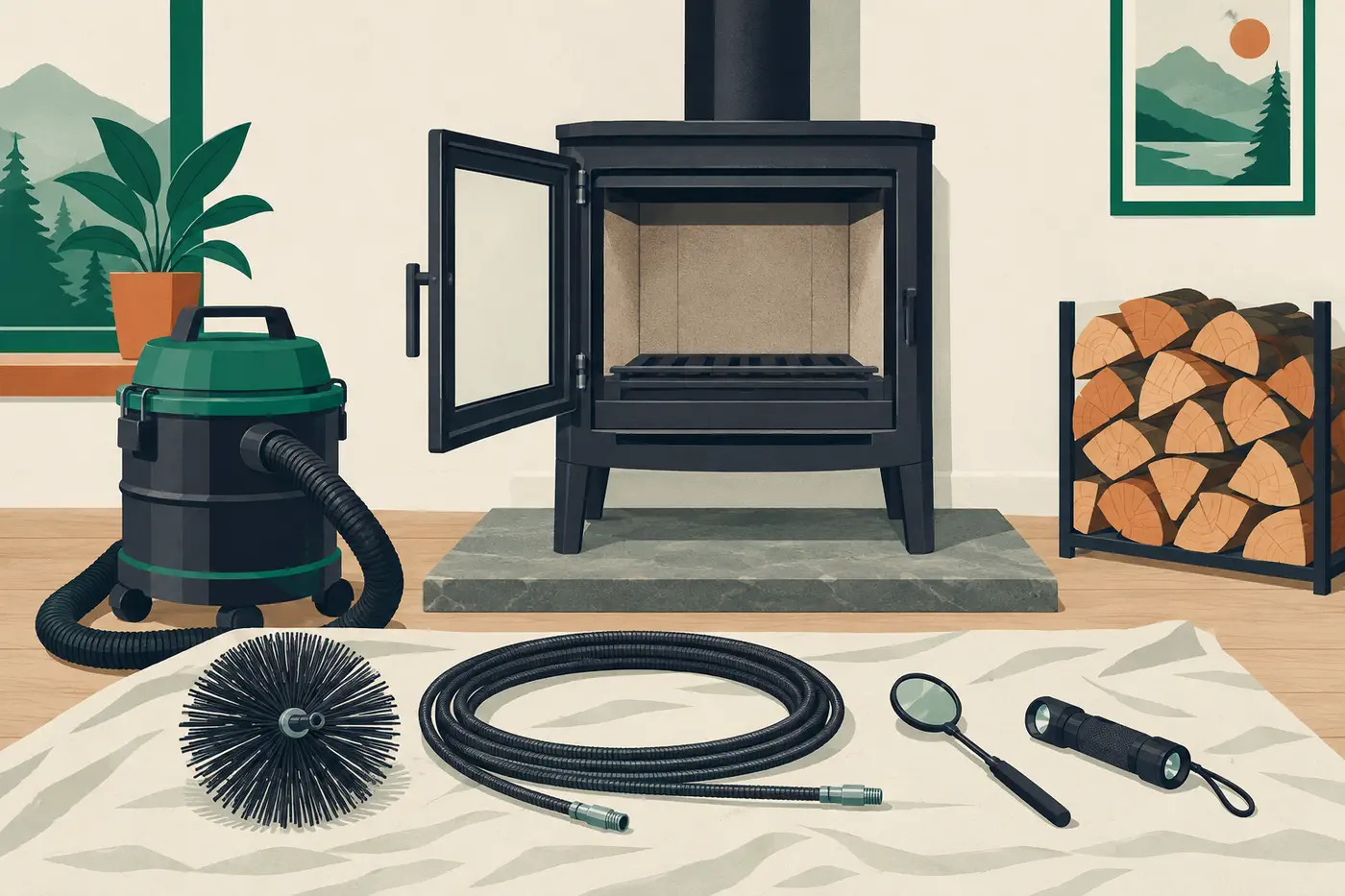
Sources: CGDIS annual report 2025, Paperjam, the government’s wood-heating guide and the smoke detector law
Who may sweep, and what it costs
Chimney sweeping is a regulated craft. On guichet.lu it appears as ramoneur - fumiste - nettoyeur de toitures - constructeur - poseur de cheminées et de poêles, a trade on list B. A firm needs an autorisation d’établissement, which requires a vocational diploma or three years of practice in the trade. A firm based elsewhere in the European Economic Area or in Switzerland can work occasionally in Luxembourg after notifying the authorities.
None of the police regulations above assigns a sweep. The duty is yours, and any authorised firm can do the work.
Some firms publish their prices online. As of November 2026:
| Firm | Service | Published price |
|---|---|---|
| Kamäinbotzer Baton (Remich) | Chimney sweep, about 45 minutes | 119 € |
| Kamäinbotzer Baton | Wood stove cleaning and servicing, about 1 hour | 130–220 € |
| Kamäinbotzer Baton | Pellet stove servicing, about 2 hours | 250–450 € |
| Ensch Schornsteintechnik (Reisdorf) | Chimney sweep | 125 € incl. VAT |
| Emil Antony (Mertert) | One chimney | 136,45 € incl. VAT |
| Emil Antony | Two or more chimneys on the same roof | 85,28 € per chimney |
Travel can be extra outside a firm’s home area. A pellet stove costs more because the appliance itself is serviced, not only the flue. These price lists do not cover removing hardened tar (débistrage), camera inspections or flue liners. Ask for a quote.
Sources: Guichet.lu, list B trades, Kamäinbotzer Baton, Ensch Schornsteintechnik and Emil Antony
How to get it done, in order
- Find your commune’s rule. Open its police regulation and search for cheminée. Note the frequency for your fuel.
- Book early. AXA reports waits of up to five or six weeks once winter starts and advises booking in spring.
- Give the sweep the details. The appliance (open fire, insert, wood or pellet stove, oil or gas boiler), the number of flues, roof access, and the date of the last sweep.
- Let the flue cool. Do not light the stove for a few hours before the visit.
- Ask what the visit includes. Sweeping only, or a check of the flue, the connection pipe and the draught as well.
- Keep the certificate. It should show the date, the flue and what was done. File it with the invoice.
- Book the heating inspection separately if you have an oil, gas or solid-fuel central heating system and it is due.
If you want to compare chimney sweeps, Fynd lists the ones working in Luxembourg on its chimney sweep page. Describe your appliance once and choose which firms receive the request.
Sources
- Ville de Luxembourg — Règlement général de police, art. 30 (version of 16.04.2024, PDF)
- Commune de Hesperange — Règlement général de police, art. 37 and 72 (coordinated text, PDF)
- Ville de Differdange — Règlement de police, art. 61 (PDF)
- Commune de Käerjeng — Règlement de police, art. 46 (PDF)
- Ville de Remich — Règlement général de police, art. 34 (PDF)
- Commune de Mondercange — Règlement de police, art. 67 (PDF)
- Commune de Larochette — Règlement général de police, art. 36 (PDF)
- Ville d’Esch-sur-Alzette — Règlement de police général, art. 28 (unofficial coordinated text, PDF)
- Ministry of Home Affairs — Circular 2024-058, model police regulation, annex 1 (PDF)
- Chamber of Deputies — Bill 8429, file and status
- Environment ministry — Heating installations: inspections
- Environment ministry — FAQ on combustion installations
- Guichet.lu — Craft trades on list B (ramoneur, fumiste)
- Guichet.lu — Concluding a residential lease: charges borne by the tenant
- AXA Luxembourg — Chimney sweeping
- Baloise Luxembourg — Ramonage de cheminée au Luxembourg, 19 February 2025
- CGDIS — Annual report 2025 (PDF)
- Paperjam — Ramoner sa cheminée, et pas uniquement pour le père Noël, 12 December 2023
- Legilux — Law of 6 December 2019 on compulsory smoke detectors
- Government of Luxembourg — Practical guide “Se chauffer au bois” (PDF)
- Kamäinbotzer Baton — Online booking and prices
- Ensch Schornsteintechnik — Kaminreinigung
- Emil Antony — Rendez-vous ramonage