
AI marketplaces
AI-powered marketplaces: how we will hire local professionals
AI is starting to change how people find a plumber, an electrician or a renovation contractor. Not only where they search, but how the job gets described, compared and handed to someone who can do it.

- 45%
- asked AI for a local recommendation
- 75%
- used more than one channel
- 18%
- would call without checking further
- 81%
- of Luxembourg craft firms are under 10 staff
The short version
- 45% of US consumers asked an AI tool for a local business recommendation in the past year, against 6% the year before.
- Almost nobody stops there: 75% used several channels in their last local search, and only 18% would contact a business on an AI recommendation alone.
- The hard part of hiring a trade is describing the job, not finding a list. That is the part a conversational marketplace can improve.
- A matching system is only as honest as the provider data under it, and recommender research warns it can quietly favour the biggest players.
A damp patch is spreading across your kitchen ceiling. You do not know whether it is a leaking pipe, the roof, or the bathroom of the flat upstairs. Someone needs to look at it. Who do you call?
You start where everyone starts. Google, plumbers nearby, four tabs open, reviews skimmed. The first firm only does bathroom installations. The second has good reviews and a website last touched in 2019. The third does not pick up. Half an hour later you have a short list of phone numbers and a ceiling that is still wet.
Now the other version. You describe what is happening in your own words. Something asks where the water is coming from, whether it is still running, whether you are in a flat or a house, how fast you need someone. Out of that comes a trade, a written description of the problem, and a handful of local firms who do exactly that work.
The second version is the premise of a new generation of service marketplaces: the platform does some of the thinking the customer used to do alone.
From phone books to Google to AI
For most of the last century, finding a tradesperson meant asking family, flipping through a directory, or calling a name you had seen on a van.
Google changed the supply of information. Anyone could suddenly see dozens of nearby businesses with reviews, photos, opening hours and a map, and compare them without needing a personal recommendation. Specialised marketplaces such as Taskrabbit and Thumbtack went a step further, gathering professionals in one place with profiles, quote requests and bookable services.

Each step made local businesses easier to reach. None of them changed who did the deciding. The customer still had to know which trade they needed, pick the search terms, read the profiles, explain the project five times and choose who to call. Access got cheap. Making sense of it stayed expensive.
That is the part AI touches. A directory answers which plumbers operate near me. A conversational marketplace can start from what is wrong, and what kind of help does that need. The gap between those two questions is where most of the customer's effort used to go.
People are already asking AI for local businesses
In March 2026 BrightLocal published its annual Local Consumer Review Survey, based on 1.002 US adults. 45% had used an AI tool to find a local business recommendation in the previous twelve months, against 6% in the year before. ChatGPT was the tool they named most often, then Google's AI Mode, then Gemini.
A sevenfold jump in a year is a real signal. What it does not mean is that chatbots have replaced search engines.
A second BrightLocal study, published in July 2026, found that 75% of consumers used more than one channel during their most recent search for a local business. Google was still dominant, and people also used social platforms, review sites, maps and AI tools in the same session. Among those who used AI, only 18% felt ready to contact a recommended business without checking it somewhere else first.
Both surveys describe US behaviour and should not be read as Luxembourg data. The direction still matters: AI is becoming one of the places people start, and none of the places where they stop.
Source: BrightLocal, Nearly Half of Consumers Are Asking AI for Business Recommendations, March 2026
The change is in understanding the job, not in the search box
Buying a television is a comparison problem. Screen size, resolution, price, brand, ratings: the attributes are defined for you, and the only difficulty is picking between them.
Hiring someone to work in your home is not that. Two people searching for electrician can need completely unrelated things. One wants a light fitting swapped. The other is rewiring a house and needs a certified installation signed off. Same search term, different scope, urgency, budget and qualification.
Traditional search struggles here because the customer often cannot describe the work. Somebody planning a bathroom might open with:
"I want to redo my bathroom but I have no idea what it costs or who I need."
A list of renovation companies is not an answer to that. A useful system asks about the dimensions, whether the layout moves, which fixtures go, whether there is plumbing and electrical work in it, and then helps write the brief.
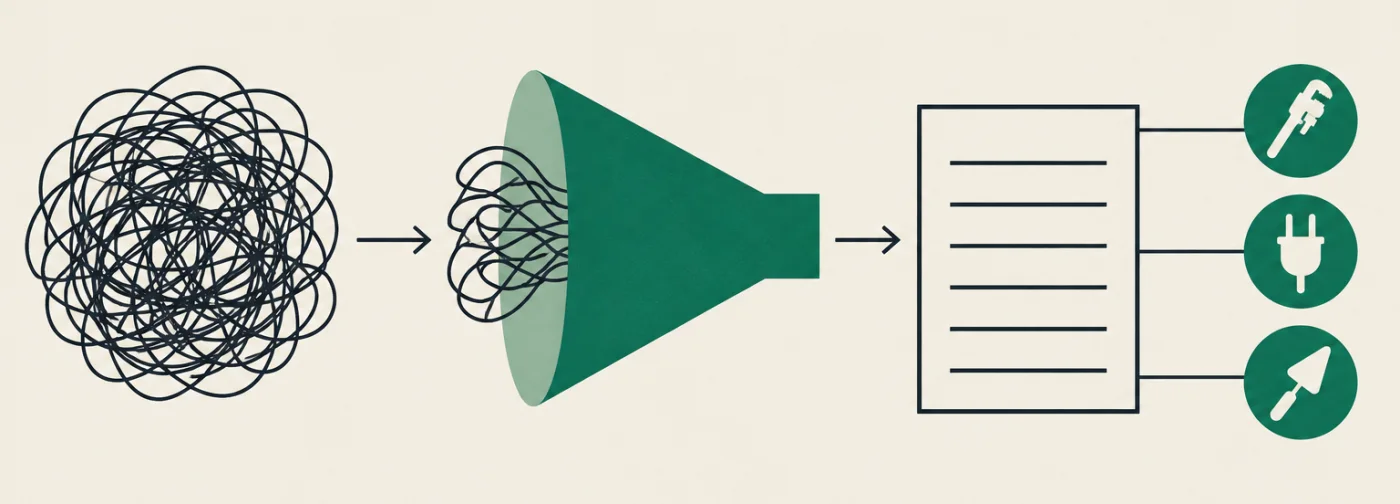
Both sides gain. The homeowner understands their own project better and asks sharper questions. The contractor gets an inquiry they can price, or decline quickly, instead of two lines of email that need three phone calls before they mean anything.
The economics here are old. In a 1997 Management Science paper, J. Yannis Bakos set out how electronic marketplaces reduce the cost of finding out about suppliers and what they sell. Newer work looks at the matching itself: a 2024 Management Science paper by Peng Shi examines optimal match recommendations in two-sided marketplaces where prices respond to the match.
None of that proves any particular AI marketplace works. It does explain why search and matching are where the value sits, and why reducing the effort on both sides is worth paying for.
Why better matching beats more listings
Marketplace growth has usually meant supply. More plumbers, more electricians, more cleaners, more competition for the same job.
Choice helps up to a point. Say you want a heat pump installed. The directory returns thirty firms under heating and plumbing. Which of them installs heat pumps? Which cover your commune? Which work on your type of building? Which want a job this size?
Thirty results are not better than five relevant ones. They are just thirty.
That is where matching earns its keep. With detailed, current provider data, a system can read a request and shortlist on location, specialisation, project type, language and whatever else actually decides the fit.
The catch is that matching is only as good as the data under it. A language model cannot know whether a contractor is free next Tuesday unless something tells it the schedule. It should not infer a certification from a business description that sounds about right. And it cannot vouch for workmanship by writing a confident sentence.
So the conversation is the visible half of the product. Verified business information, a working route to contact, and some way of keeping records current are the half that decides whether the recommendation was any good.
Luxembourg is a good test case
The problem is sharper here than in a large market.
According to the Chambre des Métiers, Luxembourg had 9.935 craft businesses in 2025, employing more than 105.000 people, and roughly 81% of them had fewer than ten employees. Those figures cover the whole craft sector rather than home repair alone, but they describe the shape of the market well enough: a few hundred thousand households served by thousands of very small firms, each with its own specialisations, service area and habits about answering the phone.
For a customer that is a fragmented market with no obvious entry point. For a provider it means competing for visibility with no marketing department and no spare afternoon.
Then there is language. As of 1 January 2026, STATEC counts foreign nationals as 46,6% of the resident population, with around 180 nationalities. A new arrival has no uncle who knows a good roofer. Even residents of twenty years run out of contacts outside their own circle, and describing technical work, reading a devis or comparing conditions in a second or third language adds friction at every step.
A customer might describe the job in English to a firm that works in French or German. A system that structures or translates that first request does not remove the need to communicate properly later, over the quote, the contract and the site visit. It does lower the barrier to starting.
Sources: Chambre des Métiers, L'artisanat en chiffres 2025 and STATEC, Population of Luxembourg, 2026
What it means for local service providers
For an independent trade or a small firm, AI recommendations change the shape of being findable.
Getting found online has meant Google rankings, paid ads, reviews and whatever brand recognition you have built. None of that goes away. But when the shortlist is assembled by a system reading provider data, the quality of that data starts to matter as much as the ranking.
A profile that says "general construction services" tells a matching system almost nothing. One that spells out specialisations, communes covered, project types, certifications and working languages gives it something to work with.
That can favour small firms. A specialist with no advertising budget can be the right answer to a specific request, and a platform that ranks on relevance gives them a route to that job which an auction for ad space does not.
The outcome is not automatic, though. Research in the Journal of Competition Law & Economics in 2023 described how recommender systems can tilt towards popular or established suppliers depending on their design and the data they are trained on. An AI marketplace can reproduce the inequality of a search results page exactly, if it keeps rewarding whoever already has the most activity.
Which leaves providers one question worth putting to any platform: how does it decide who gets recommended? And it leaves operators with a job larger than building a convincing chatbot.
Trust still decides who gets hired
The common mistake is assuming that a smarter search produces a more trustworthy answer. It does not.
A system that recommends the wrong contractor, invents a qualification or works from a three-year-old business record is worse than a plain directory, because the answer arrives looking personalised and considered. Confidence is part of the output.
So transparency is not a nice-to-have. Customers need to know who the recommended business is, what the recommendation rests on, and whether anybody paid for the placement. They need the things people actually check before letting someone into their house: identity, qualifications, experience, reviews, insurance where it applies, and quote terms in writing.
And they are checking. BrightLocal's 2026 survey found that 88% of consumers who used AI for local recommendations fact-checked the reviews the AI referred to. People will take the help and verify it anyway.
European consumer rules add obligations of their own, including trader information and disclosure where ranking has been paid for, with the detail depending on the platform and the case.
That makes trust the competitive position, not model quality. A platform that recommends reliably, explains itself and leaves the choice with the customer beats one promising the perfect professional.
From recommendations to doing the work
Most consumer use of AI in local search is still question and answer. Ask, receive a shortlist, carry on by yourself.
The technology is moving towards systems that do things rather than describe them. These get called agents, and in a service marketplace the distinction matters.
Instead of naming five electricians, an agent with the right connections could draft the project brief, send it to the firms the customer picked, collect the replies and lay the quotes side by side. With the right integrations and permissions it could handle scheduling and the follow-up nobody enjoys.
Take a kitchen renovation. Today that means finding an electrician, a plumber, a tiler and a kitchen fitter separately, explaining the same job four times, coordinating four site visits and comparing four quotes that each cover a different scope. A marketplace could organise that: identify the trades, send each one consistent information, track what came back, and flag where the quotes disagree.
That is a plausible direction, not a shipped feature. Getting there depends on integrating with provider systems, verifying what goes out, handling the exceptions that make up half of real work, and asking the customer before anything consequential happens.
The useful agent is probably not the one that decides for you. It is the one that removes the admin and leaves the decisions where they belong.
Where Fynd fits
Conversational discovery is the thinking behind Fynd.lu as well.
Alongside local provider profiles, Fynd runs an AI assistant that helps people describe a project in their own words, clarify what the job involves, then look at relevant professionals and request quotes.
It aims at the same weakness: customers usually know what outcome they want, and not how to specify the work or who performs it. Whether that produces faster replies, better matches or more completed jobs is a question for usage data, not for an article.
The underlying problem is not in doubt. Hiring a professional should not require becoming an expert in their trade first.
What changes for everyone
AI is not about to replace Google, a neighbour's recommendation or a directory. People will keep asking around, reading reviews, comparing prices and meeting the person who is going to knock through their wall. When the job is expensive, no model substitutes for experience and clean workmanship.
What can change is the distance between "I have a problem" and "I have found someone qualified."
The old model of online discovery was about access: show the customer everything. The one taking shape is about sense: help them work out what they need, and take the next step.
For customers that means less searching and fewer irrelevant results. For small firms it means inquiries that already explain themselves. For marketplaces it means a new burden of proof, because a recommendation presented as an answer has to deserve being treated as one.
The platforms that win will not be the ones with the biggest directory or the best demo. They will be the ones whose recommendations hold up.
Nobody wants to spend an evening looking for a plumber. They want the leak fixed.
Research note: the BrightLocal surveys describe US consumers and are not representative of Luxembourg. The marketplace research establishes why search and matching carry economic value; it does not measure the performance of any individual AI marketplace.
Research sources
- BrightLocal (2026) — Nearly Half of Consumers Are Asking AI for Business Recommendations
- BrightLocal (2026) — Where Are Your Customers Really Searching?
- Peng Shi (2024) — Optimal Match Recommendations in Two-Sided Marketplaces with Endogenous Prices, Management Science
- Journal of Competition Law & Economics (2023) — Recommender Systems and Supplier Competition on Platforms
- Chambre des Métiers (2025) — L’artisanat en chiffres
- STATEC (2026) — Population of Luxembourg
- European Commission (2025) — Digital Services Act: keeping us safe online