The small business that never closes: what AI agents can actually do
An agent can take the call, qualify the job and write it up. It should not price a renovation, judge a safety risk or decide a refund. Where the line sits, and what the research says about crossing it.
Published 13 October 2026·13 min read
31%
of SMEs use generative AI
29%
of those use it in core activities
87%
want a human still reachable
70%
of eligible AI costs funded in Luxembourg
The short version
31% of SMEs across seven countries use generative AI, but only 29% of those use it in their core business activities.
An agent differs from a chatbot by taking actions through tools. That is also where it breaks: τ-bench found 2024 agents completed under half their tasks.
Decide authority before capability. Answering and collecting can run automatically; prices, refunds and safety calls stay with a person.
87% of customers say a company using AI in service must still give them access to a human.
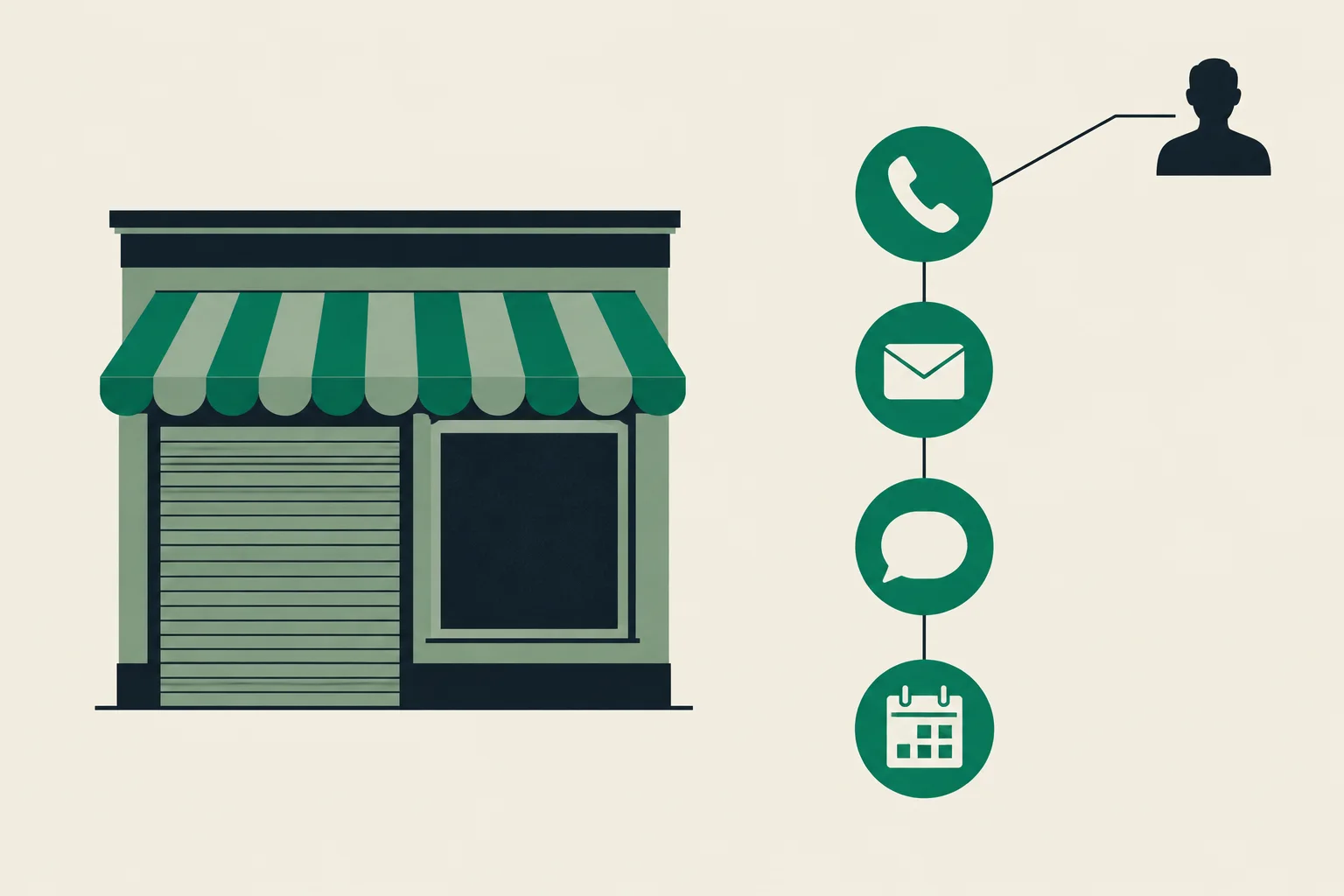
It is 7.15 p.m. and the owner of a small electrical company outside Luxembourg City has finished for the day. The requests have not.
One customer wants to move an appointment. One has questions about installing an EV charger. A third needs a price for outdoor lighting. And there is a missed call from somebody reporting a fault.
None of that is unusual. It is the ordinary traffic of a service business, arriving while the one person who can answer it is up a ladder.
Traditionally it all waits until morning, unless the owner spends another hour on the phone after dinner.
An agent could take part of it. Collect the details for the charger enquiry, check the calendar for slots, write up the lighting job. The reported fault gets flagged for a person rather than booked like a routine visit. By morning the owner has something more useful than four missed calls.
The opportunity is not automating more work. It is working out which tasks can finish without a person, and which cannot.
That line is what separates a useful deployment from an expensive experiment.
Beyond chatbots: what makes an agent different
Businesses have been automating customer contact for decades. Phone menus route callers. FAQ pages answer the easy questions. Booking systems take appointments without reception.
An agent adds one thing to that: instead of following a fixed script, it can read a request, work out what it needs, pick from a set of permitted tools and take an action inside a defined workflow.
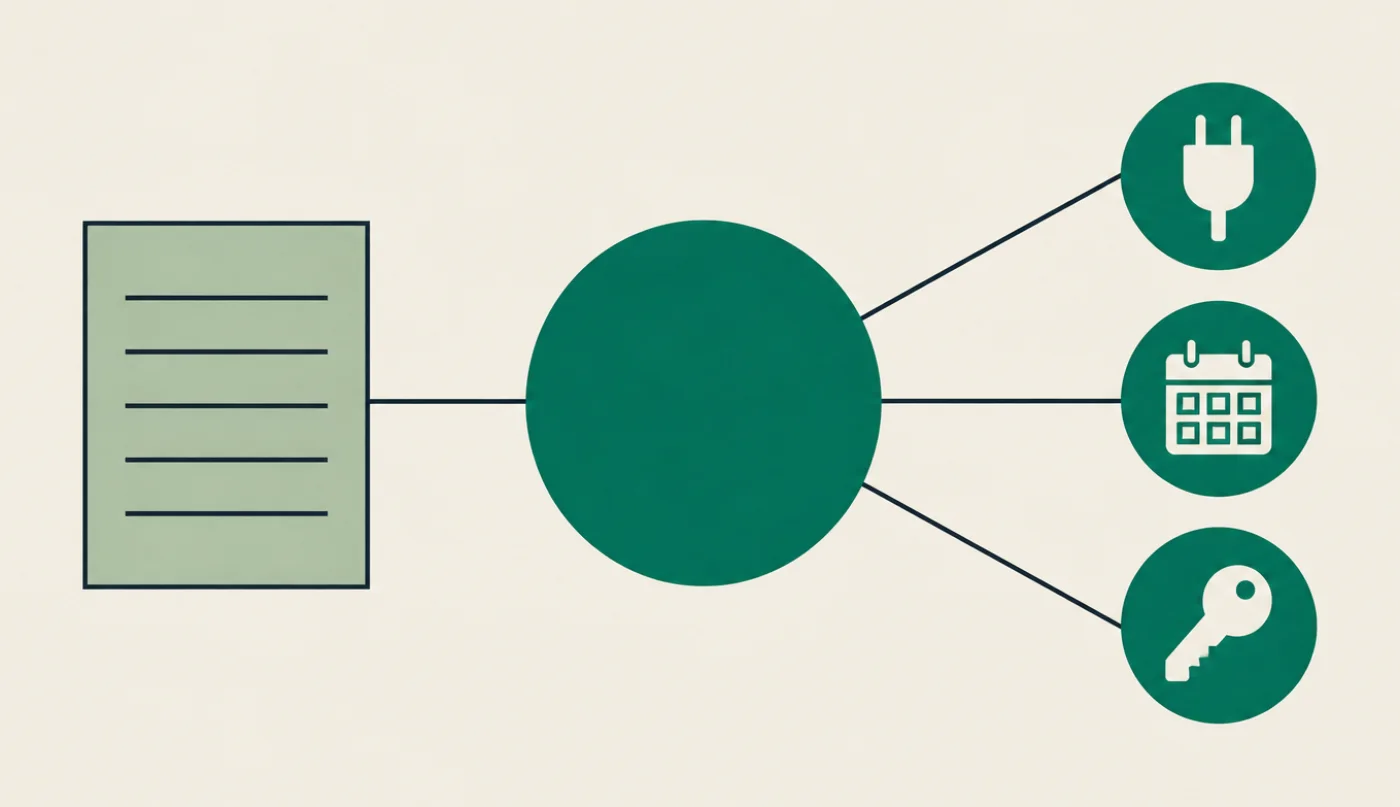
OpenAI's practical guide to building agents names three parts: a model that runs the task, tools that let it reach other systems, and instructions that set how it behaves.
The three parts of an agent: a model that runs the task, instructions that bound it, and tools it is allowed to use.
The example makes it concrete. A chatbot answers a question about opening hours. An agent connected to a scheduling system checks real availability, offers a slot and completes the booking.
The difference is not that the second one sounds more human. It is that it does something.
Which also means it depends on what it can reach. An agent cannot check real availability without a working calendar connection, and it must not invent a confirmation when that connection is down.
And not every process wants an agent. For predictable work with clear rules, ordinary automation is simpler, cheaper and more reliable.
So the question is not whether a business can deploy an agent. It is which part of the business would be better with one.
In November 2025 the OECD published one of the more useful studies of generative AI among small and medium businesses, surveying more than 5,000 SMEs across Austria, Canada, Germany, Ireland, Japan, South Korea and the United Kingdom.
31% were using generative AI, through the respondent or another member of staff. Among those already using it, 65% reported better employee performance, 45% reported saving money, 35% said it let them do things they could not do before, and 26% reported higher revenue.
Those are self-reported experiences, not audited returns, and the study looked at generative AI broadly rather than at autonomous agents.
One number is more telling than the rest. Only 29% of the SMEs using generative AI said they used it in their core business activities. The rest were using it around the edges: writing, preparing information, marketing, admin.
That gap is the distance between where adoption actually is and where the agent pitch starts. A company using AI to draft emails is not thereby ready to let it negotiate with customers, issue refunds or decide the week's job schedule.
Going from assistance to action is a different level of integration and control.
The useful cases are duller than the demos. Recurring, time-consuming work with a clear objective: take an enquiry, book a slot, prepare information, chase a reply. Tasks that need little judgement, but that constantly interrupt work that does.
1. Answering calls and qualifying enquiries
A plumbing firm gets a call while its two fitters are at a customer's house. The caller wants a water heater replaced.
A voice agent can answer, establish what is needed, take the address and contact details, and ask whether this is a replacement or a fault. If the firm has defined its service area and the work it accepts, the agent can check the enquiry against both, write it into the CRM and send it to the right person.
That is worth more than a voicemail with a phone number. It is enough context to decide what happens next.
Qualifying is not diagnosing, though. The agent must not conclude that a possible gas, water or electrical hazard can wait. An enquiry that suggests immediate danger needs an escalation path, not a conversational resolution. And it should not promise an engineer within the hour unless the firm's systems and service policy can back that promise.
Collecting information about a problem is a contained task. Taking responsibility for fixing it is not.
2. Booking, confirming and rescheduling
Scheduling suits an agent because most of the work is gathering details and checking availability. A salon can take routine bookings after closing. A dental practice can collect requests while reception is busy. A consultant can offer intro slots without four emails.
A dependable scheduling agent needs more than a calendar link. It has to know which services are bookable, how long each takes, who can deliver them, and the rules on cancellation and rescheduling. It has to verify that the booking actually succeeded before telling the customer it did.
If the calendar is unreachable, the right answer is to record a request or offer a callback. Not to confirm.
Rescheduling an existing appointment may need an identity check, so that one customer cannot move another's slot.
These are ordinary operational requirements, and skipping them turns a convenience into a source of confusion. The AI handles the conversation. Booking rules and system checks decide what it is allowed to do.
3. Preparing quotes and project briefs
For trades, quoting is largely admin. A bathroom renovation arrives as two sentences of email, and before anything can be priced the contractor needs dimensions, photos, the state of the existing installation and some idea of what the customer expects.
An agent can collect that through a structured conversation: spot what is missing, organise the answers into a brief, open a draft in the quoting system. Where there is an approved price list, it can help with simple estimates from predefined rules.
It should not issue binding quotes for complex work. A renovation price depends on what a site visit reveals: the state of what is already there, hidden defects, access, the real scope of labour. A convincing generated number can still be wrong.
For anything complex the sensible split is that AI prepares and a qualified person approves. The saving is in the preparation, not in the judgement.
4. Following up
Plenty of small businesses lose work simply because nothing chases it. A quote goes out and nothing comes back. A customer owes photographs before a visit can be booked. Somebody has an appointment tomorrow and no reminder.
An agent connected to the records can see those loose ends and move them along: prepare a reminder, ask for the missing photos, tell an employee a quote is sitting unanswered. It should also stop the moment the customer replies or asks for a person.
The operative word is appropriate. Not every unanswered quote deserves three reminders. A business has to set how often follow-ups go out, through which channels, and when the sequence ends. Automated persistence without a limit does not improve a customer relationship.
Follow-ups also have to respect privacy and electronic communications rules, especially once the purpose crosses from servicing a request into marketing.
5. The work behind the scenes
Not every useful workflow faces the customer. A small firm takes requests by phone, email, web form and messaging app. Somebody then reads each one, works out what it is about, enters the details and assigns the next action.
An agent can consolidate that: classify what comes in, draft job records, flag missing information, prepare summaries, and queue what needs a person.
But writing to internal systems brings its own risk. An agent that can create a job record does not need permission to delete customer records, edit invoices or read the whole finance database. Its access should cover the tasks it is authorised to do and nothing else. The less authority it holds, the less damage it does when it goes wrong.
The hard part is not making it work once
Demos show a task completing. A customer asks, the agent picks a tool, the right answer appears, the end.
Real businesses are less obliging. Customers change their minds. Systems go down. Information is missing. Requests contradict policy. An agent can read the intent perfectly and still fail at the action.
In 2024 researchers published τ-bench, a benchmark for language-model agents working with simulated users and business systems in settings such as retail and airline support, where the agent has to use tools while respecting policy. Even the leading agents of the time completed fewer than half the tasks, and were inconsistent across repeated attempts on the same task.
That describes specific models and tasks in 2024 and is not the 2026 failure rate of commercial products. The point it established still stands: sounding capable in conversation is not the same as reliably completing a task in a real system.
A fluent voice and a good demo are not evidence. What matters is whether the right action happens, under the right conditions, every time.
Before asking what an agent can do, decide what it may do. This is a question about authority, not about trust in the technology.
Business task
Appropriate autonomy
Answer questions from verified business information
Automatic, escalating when the information is missing
Take a new enquiry
Automatic, with privacy and data-handling controls
Book an available slot
Automatic once eligibility, identity and calendar checks pass
Prepare a quote
AI drafts; a qualified person approves anything complex or binding
Change a price or grant an exceptional discount
Explicit business authorisation
Handle an urgent safety or sensitive request
Escalate to a qualified person or the right emergency channel
Refund, transfer money or enter a contract
Keep under properly authorised human control
These are recommended boundaries, not a rule every business must copy. The right level depends on the risk, the reliability of the system and what a mistake costs.
Security researchers have a name for getting this wrong. The OWASP project calls it excessive agency: an AI system with access to functions it does not need, permissions beyond its job, or the ability to take consequential actions without approval. An agent given access to customer email so it can summarise threads has no business also being able to send mail to arbitrary recipients.
The recommendation is the obvious one. Minimise permissions, restrict the toolset, require human approval for high-impact operations.
In practice the most useful agent is rarely the freest one. It is the one whose responsibilities are drawn most carefully.
There is a constraint that no amount of engineering removes: what customers will accept.
In August 2026 Gartner published a survey of 3,566 business and consumer customers, run in February and March. The results cut both ways. Half said interactions were easier when companies used generative AI. And 87% said a company using generative AI in customer service must still provide access to a human agent.
Read that as a warning against using automation as a wall. Someone booking a routine appointment is perfectly happy talking to software. Someone disputing a large invoice, dealing with something sensitive, or trying to explain a situation that does not fit the script feels very differently.
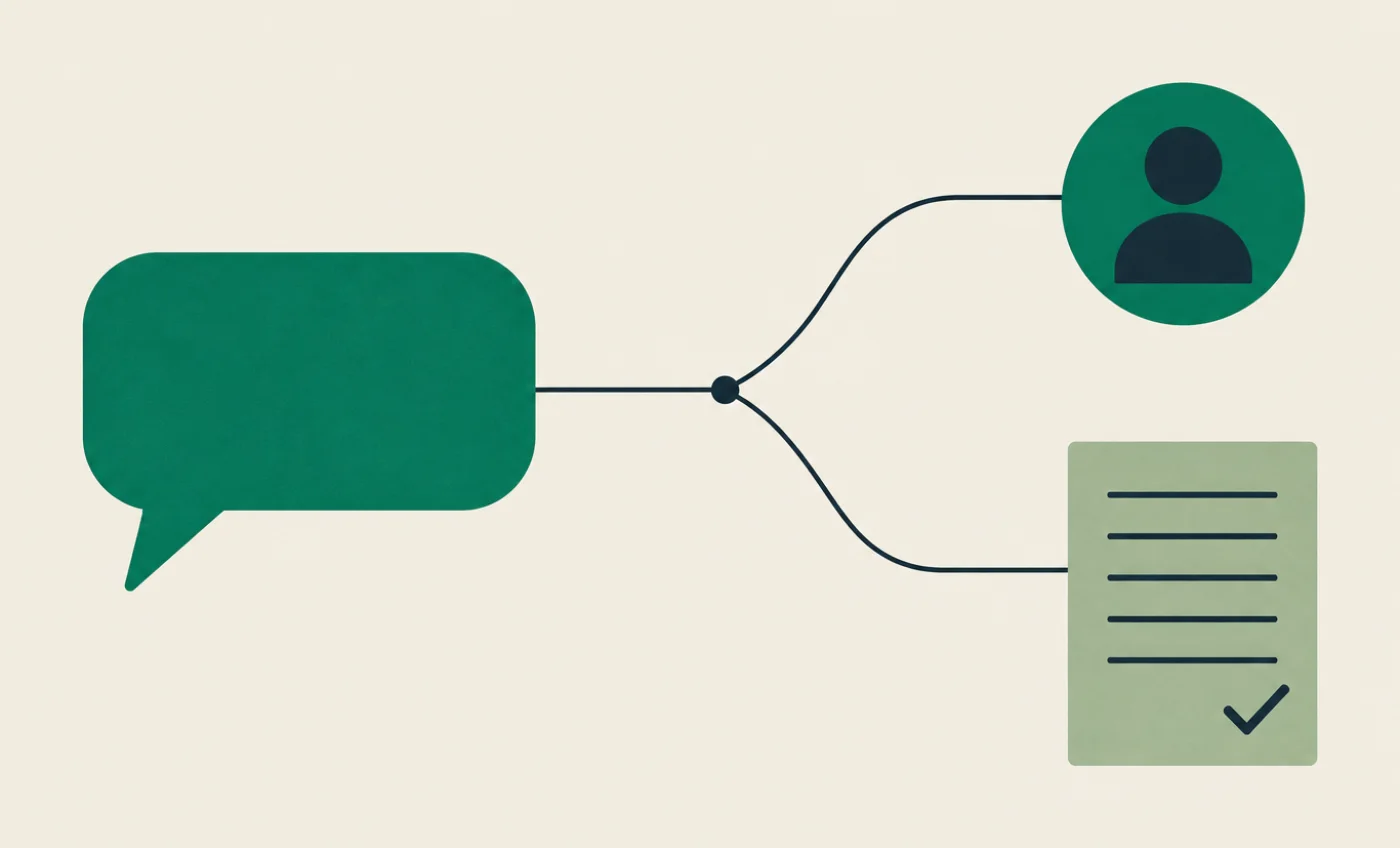
A good system knows when it cannot help and offers a real alternative: transfer the call, book a callback, or open a clearly prioritised case for somebody to pick up. Telling a customer the AI cannot answer and then refusing to connect them to anyone defeats most of the point.
Both endings are a success. A handover is part of the service, not a failed automation.
A handover is not a failed automation. It is part of the service.
The case is sharper for small service firms here than for large ones anywhere.
According to the Chambre des Métiers, Luxembourg had 9,935 craft enterprises in 2025, roughly 81% of them employing fewer than ten people. In a firm of three or four there is no receptionist, no marketing department and no back office. The owner takes enquiries between appointments, writes the quotes and supervises the work. Taking even part of that off the pile buys time for the work that actually earns.
Then there is language. Depending on the customer base, enquiries arrive in French, Luxembourgish, German, English or Portuguese. A multilingual agent can collect the details in whichever one the caller uses and hand the business a structured summary.
That has to be tested language by language. A product that handles standard French or English well can be considerably worse at Luxembourgish, at regional accents, at technical vocabulary, and at the mid-sentence switching that is normal here. Test it on real customer conversations, not on the vendor's list of supported languages.
Funding for eligible projects
Luxembourg co-funds some of this. Under SME Packages – AI, a qualifying business can receive aid covering 70% of eligible project costs, for approved projects between €3,000 and €25,000 excluding VAT. The route runs through a preliminary assessment at the House of Entrepreneurship or eHandwierk, then approval, then implementation, with reimbursement after the fact.
An agent integrated into a company's processes is worth raising under the programme. Eligibility is not automatic, and ongoing subscriptions and individual software licences should not be assumed to qualify.
Data protection and disclosure are part of the design
An agent handling customer conversations processes personal data: names, addresses, phone numbers, appointment details, transcripts, recordings.
So GDPR comes before go-live, not after. The business needs a lawful basis, clear information for customers, retention periods that make sense and the right arrangements with its technology providers. It should also stop collecting anything the task does not need. An agent booking a routine cleaning has no reason to ask for sensitive personal details.
Recording calls adds obligations of its own. The European Data Protection Board's guidance for small businesses sets out that callers have to be told what the recording is for, who receives it and what rights they have.
Disclosure is becoming a legal requirement too. Transparency obligations under Article 50 of the EU AI Act, for certain systems that interact directly with people, took effect on 2 August 2026. The European Commission's guidance is that people should be told when they are interacting with AI, subject to the regulation's own conditions and exceptions. For a voice agent, an opening line explaining that the caller is speaking to an AI assistant on behalf of the business does the job, and is better than letting them assume otherwise.
A workable deployment also needs the unglamorous parts: access controls, a record of what the agent did, monitoring for failures, a way to switch it off, and a defined fallback when a connected system is down.
The temptation is to automate five things at once: answer calls, send quotes, manage the diary, chase invoices and update the customer database.
A narrower start is easier to judge and easier to control.
Take the plumbing firm that keeps missing calls from site. Its first workflow does four things: answer the call, find out what the caller needs, collect the contact details, deliver a usable summary. Once that runs reliably, connect the calendar. Then add follow-ups.
That incremental approach is what both OpenAI and Anthropic recommend: start with simple, well-defined workflows rather than reaching for multi-agent complexity.
It also makes the commercial question answerable. Before switching anything on, measure the unanswered calls, the time spent processing enquiries, and how many qualified requests became customers. Afterwards, compare against the conversations the agent actually handled.
Measure outcomes rather than volume. A successful call is one that produced something usable: a confirmed and accurate booking rather than a customer who expressed interest, an enquiry staff can act on, a routine request resolved or handed over cleanly without anything misleading being said.
Track the other side too. Errors, abandoned conversations, complaints, and time spent correcting records the agent created. An agent that saves five minutes on a booking and creates fifteen minutes of correction has saved nothing. One that books appointments customers never meant to confirm is hiding a more expensive problem behind a good number.
The question is whether total work goes down while the customer's experience holds or improves.
Where Fynd fits
For a Luxembourg service business, finding customers and answering them are the same problem viewed from two ends. An enquiry is worth nothing until somebody responds to it.
That is why Fynd.lu runs an AI voice agent for businesses alongside the local services marketplace. Fynd describes the agent as answering incoming calls, qualifying the request and sending the business a summary.
Those are deliberately contained functions, and they cover the case that costs small firms the most: a call arriving outside working hours or while everyone is on site. More advanced workflows, confirmed booking or automated CRM updates, depend on the integrations, permissions and configuration of the particular system.
The point is to connect getting the enquiry to doing something with it. For a small contractor that is worth more than another disconnected tool.
The small business that never closes?
An agent cannot install a boiler overnight, inspect a building, or settle a serious complaint in software. Nor should it. Some decisions need expertise, a conversation and somebody who carries responsibility for the result.
But a surprising amount of administration surrounds those decisions. Enquiries have to be received. Appointments have to be arranged. Details have to be collected. Customers need updates, and employees need information before they can act.
That is the gap worth closing. The case for this technology is not that a business can run without people. It is that it stops depending on somebody being free to perform every administrative step.
The owner can finish the day without leaving every enquiry unanswered. The receptionist can look at the customer in front of them. The contractor can finish a job without stopping to write down another phone number.
The small business of the future still closes at six. It just stops putting every conversation on hold until nine the next morning.
Research note: the OECD study covers generative AI broadly rather than autonomous agents. Gartner's figures describe customer attitudes, not agent performance. The τ-bench results reflect the models and tasks evaluated in 2024 and are not a current failure rate for commercial systems. The workflow examples are illustrative, not measured results from named Luxembourg businesses.