
Renovation aid
Renovation aid in the right order: Klimabonus (formerly PRIMe House) before the work starts
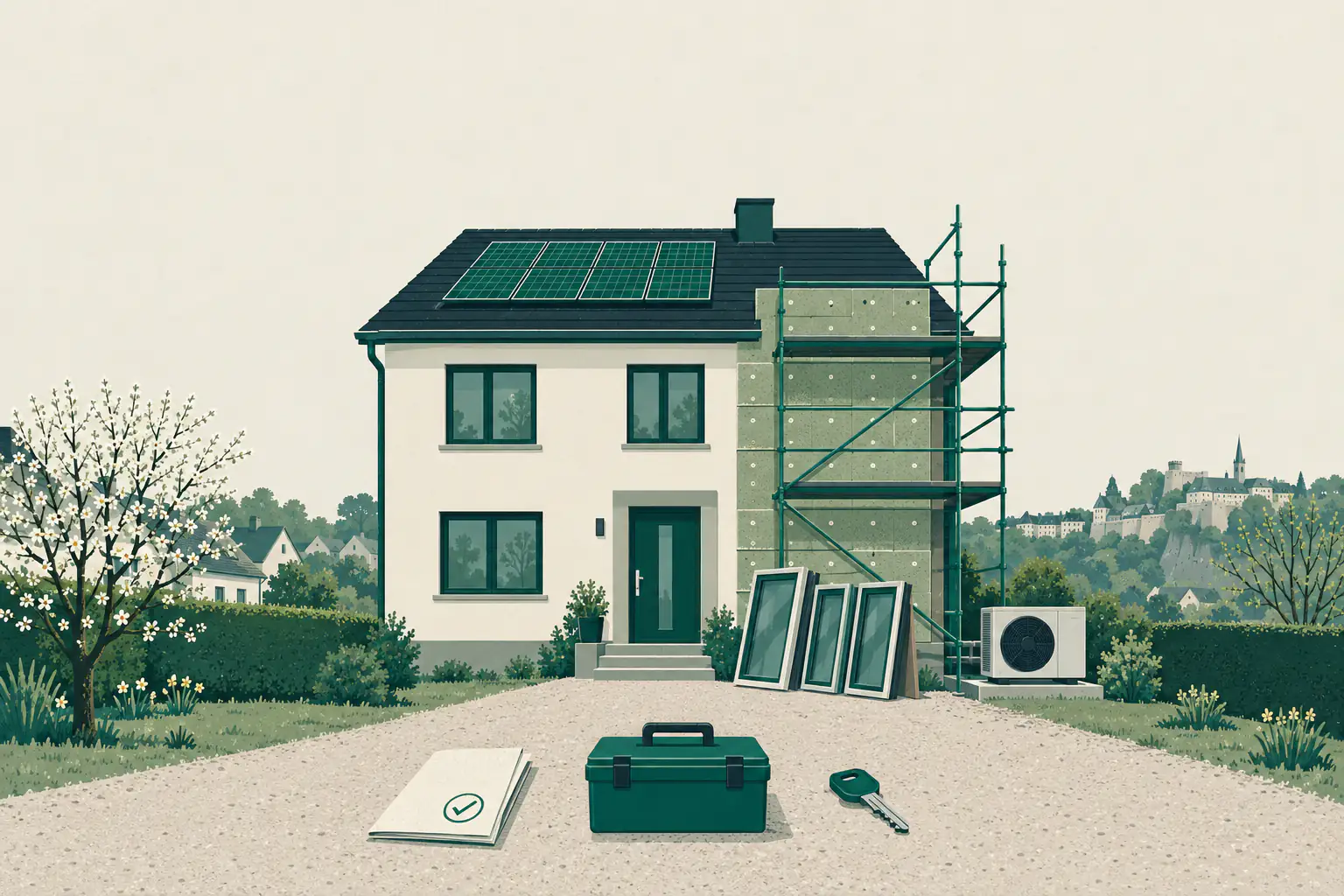
Insulation, windows, heat pumps and solar panels can each get Klimabonus Wunnen aid, but each has its own conditions, deadlines and order of steps. For insulation and windows, the request for approval goes in before the work starts.
- 30 June 2027
- deadline for the higher rates
- 10.000 €
- maximum solar aid, from 15 kWp
- 12.000 €
- heat pump replacing oil or gas, house
- 3%
- VAT instead of 17%, with conditions
The short version
- Klimabonus Wunnen, the scheme that replaced PRIMe House in 2022, aids insulation, windows, heat pumps and solar panels. Each has its own conditions, deadlines and order of steps.
- For insulation and windows, the request for an accord de principe goes in before the work starts, and Guichet.lu tells you to wait for it. New windows need walls or a roof at U 0,85 or better, or controlled ventilation.
- Heat pumps and solar panels are claimed after installation, but the order date, the payments before the final invoice and the payment route are settled when you sign.
- Requests for an accord de principe submitted by 30 June 2027 get rates up to 20% higher. A heat pump ordered by then gets 2.000 € more.
Current as of 27 October 2026.
A house built in 1994, 150 m² of living space, still on its original oil boiler.
The owners have a plan for the next two years. Insulate the façade and the attic floor, replace the windows, put solar panels on the roof, and eventually swap the boiler for a heat pump.
A façade company can start in March and asks for a 30% deposit to book the slot. The solar installer has a quote ready to sign.
Each of those projects can get Klimabonus aid. But each has its own rules about what has to happen first, and some of the money depends on steps that have to come before a quote is signed or the work starts.
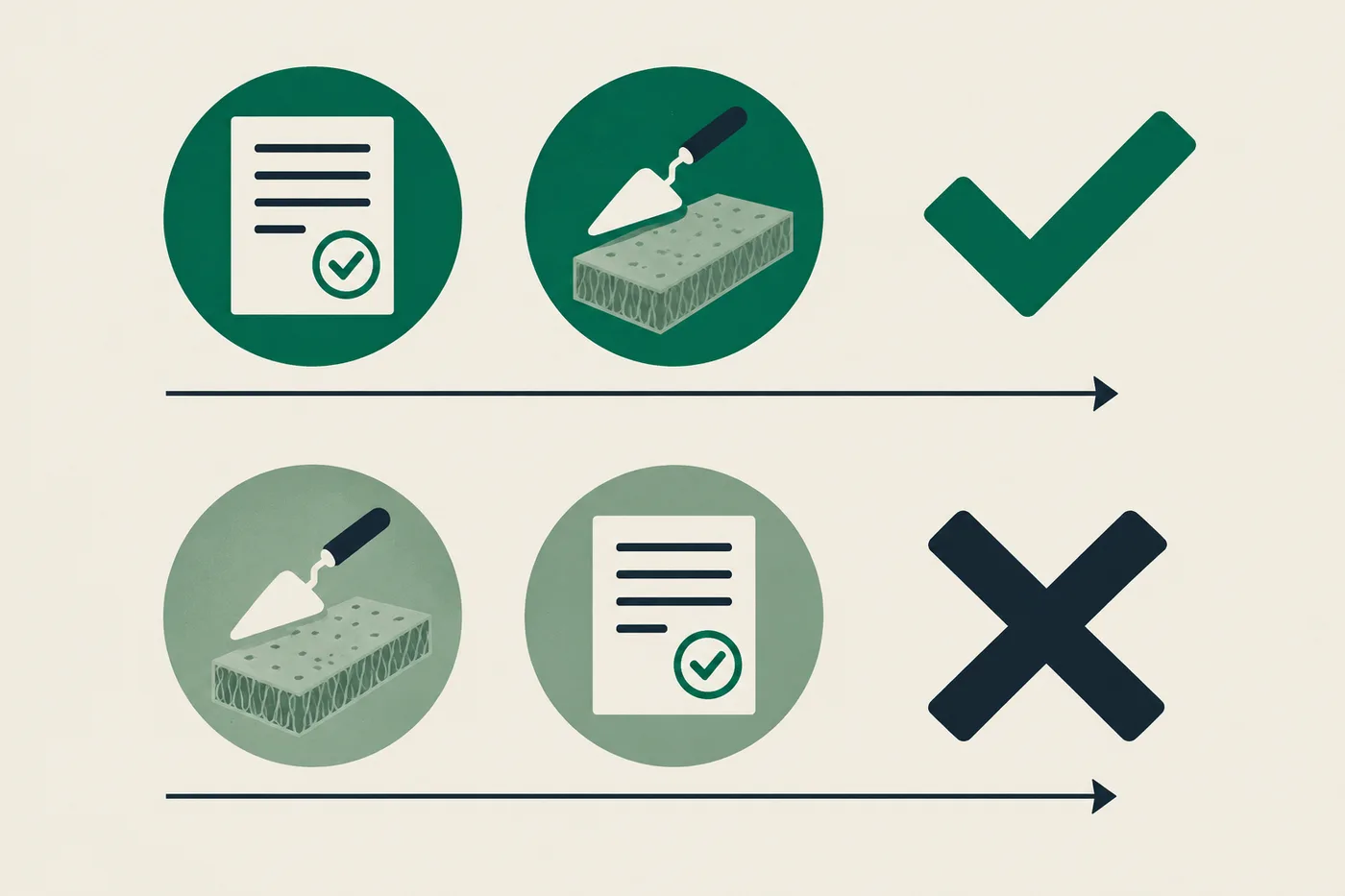
Klimabonus is not a discount you claim at the end. For insulation and windows, the request for approval goes in before the work starts. For heat pumps and solar panels, the order date and what you pay up front decide what you can get and how. The money is real. The order decides whether it reaches you.
Klimabonus, PRIMe House: what is what
Older advice, and many installers, still talk about PRIMe House. That was the name of Luxembourg’s housing energy aid until 2022, when it was replaced by Klimabonus Wunnen.
In July 2026 the Chamber of Deputies renewed Klimabonus Wunnen with the law of 24 July 2026, backdated to 1 January 2026. The new version raised several amounts, extended prefinancing to more kinds of work, and introduced temporary increases agreed in the June 2026 tripartite. Those increases depend on dates, which is why this article keeps returning to 30 June 2027.
There is no single deadline for the whole scheme. Each kind of work has its own invoice window and claim period, set out below.
The aid is managed by the Environment Administration. Applications go to the Guichet unique des aides au logement, and Klima-Agence gives free, independent advice.
Sources: law of 24 July 2026 and Klimabonus Wunnen 2026-2030 presentation
The order, on one page
| Work | Before the work | After the work | What the state pays |
|---|---|---|---|
| Insulation of roof, walls, floors | Request for an accord de principe | Payment claim | 25–155 € per m² |
| Windows | Request for an accord de principe, walls or roof at U 0,85 or ventilation | Payment claim | 80 € per m² |
| Heat pump | Dated order | Aid application | 12.000 € for air-to-water, house replacing fossil heating |
| Solar panels | Choose the route; for prefinancing, 30% at most paid before the final invoice | Aid application | Up to 10.000 € |
| 3% VAT | TVA logement direct application; solar panels have a separate 3% rate | Or a TVA logement refund | 14 points of VAT |
The rest of this article goes through each line. All the worked amounts are for a single-family house; flats and apartment buildings have their own amounts and caps.
Insulation and windows: the request comes first
Insulation and window aid is for homes in buildings more than ten years old, counted from the date of the building permit.
The law requires the request for an accord de principe to be submitted before the renovation work starts. Guichet.lu goes further and tells homeowners to obtain the accord de principe before starting. The safe course is to wait for the decision. If work has already started on your project, ask the Guichet unique how your file is treated; that is an individual assessment.
There are two routes.
With energy advice, for several elements. An approved energy adviser assesses the house, writes the energy advice report and a renovation concept (form COAS-2026), and you submit the request with the energy performance certificate (CPE) from before the work and a cost estimate from the adviser or a checked quote for each measure. The state pays for part of the advice: 2.000 € for a single-family house if the request is submitted between 1 January 2026 and 30 June 2027, and 1.700 € after that. This is the route for a façade, roof and windows together.
Without energy advice, for a single element only. The work has to be done by an approved company or followed by an energy adviser, who signs a description of the work (form DESC). The request includes a copy of the building permit or proof of the building’s age and a cost estimate checked by the company or adviser. The adviser’s support is aided at 400 €, plus 100 € for checking that the quote complies.
On both routes the application form is DEPA-2026, and requests go in through MyGuichet.lu, by post or in person. Check the current list of documents for your route on Guichet.lu before you file.
What it is worth
Insulation aid is paid per square metre of renovated surface. The rate depends on where the element is, which insulation material is used, and which of three efficiency standards it reaches, from III (the minimum) to I (the best).
| Per m² | Standard III | Standard II | Standard I |
|---|---|---|---|
| Wall, roof or floor facing outside, mineral insulation | 70 € | 80 € | 100 € |
| Same, ecological insulation | 105 € | 120 € | 140 € |
| Ceiling under an unheated attic, mineral insulation | 30 € | 40 € | 60 € |
| Same, ecological insulation | 50 € | 60 € | 75 € |
These are the higher rates. They depend on the date the request for an accord de principe is submitted, between 1 January 2026 and 30 June 2027, not the date it is granted, and the work has to be invoiced by 31 December 2030. Afterwards the rates are roughly 15 to 20% lower: the 80 € for a mineral-insulated façade at standard II becomes 70 €, for example. Ecological façade insulation with cladding goes up to 155 € per m². Windows and balcony doors get a single rate of 80 € per m², then 70 €.
Several adjustments change the total. Insulation fitted only on the inside is paid 25% less. Insulation made from fossil materials is only aided with a minimum share of recycled content, with exceptions for walls against the ground, floor slabs and green roofs; Guichet.lu’s wording on the exact threshold varies, so have your adviser confirm it for the product you choose. There are 15 € per m² supplements for recycled mineral insulation, certified ecological insulation and green walls or roofs.
On the energy advice route there is also a class bonus. If the renovation lifts the house by at least two energy classes to class C, B, or A and A+, the aid for the envelope measures goes up by 20%, 30% or 50% respectively. The energy performance certificates from before and after the work are the proof.
For the 1994 house, 140 m² of façade at standard II with mineral insulation comes to 140 × 80 € = 11.200 €. Insulating 90 m² of attic floor the same way adds 90 × 40 € = 3.600 €. Neither figure includes a class bonus.
The window condition
Windows have the condition people most often miss.
New windows are aided if the exterior wall or the roof of a heated attic reaches a U-value of 0,85 W/m²K or better, or if the home has controlled mechanical ventilation. The glazing itself has to reach Ug 0,6, which in practice means triple glazing.
A wall from 1994 without added insulation rarely reaches 0,85. Windows replaced on their own in such a house will usually get nothing. Planned together with façade insulation in the same energy advice project, they can qualify; ask your adviser to confirm how the wall value is assessed for your project.
For prices, see what windows and doors cost in Luxembourg and attic insulation costs.
After the work
Once the work is done, the company or adviser provides the confirmation form CONF-2026, and you send it with the paid invoices, proof of payment and your bank details. On the energy advice route you also need the adviser’s final conformity report and the energy performance certificate from after the work. You have four years from the end of the year of the invoice, and no later than 31 December 2039.
From 1 January 2027 there is a second option for invoices dated from then on: a registered adviser or company files the request before the work starts and deducts the aid from the invoice. Each measure then needs its own request and invoice.
Sources: Guichet.lu, renovation with energy advice, single-element renovation and renovation overview
Heat pumps: the order date
Heat pumps need no accord de principe. You apply after installation. What matters before is the order.
In an existing single-family house, an air-to-water heat pump that replaces a fossil or direct electric heater gets 12.000 € if it is ordered between 1 January 2026 and 30 June 2027 and invoiced by 31 December 2028. Outside that window the amount is 10.000 €. A ground-source heat pump gets 14.000 €, otherwise 12.000 €. Without a heater being replaced, each amount is 4.000 € lower. Keep the dated order: it is one of the documents the application asks for.
On top of that, removing an oil tank adds 1.500 €, adapting radiators adds half the cost up to 2.000 €, and replacing an oil boiler in a drinking-water protection zone adds 2.000 €. The installer has to request the Chambre des Métiers inspection within a month of commissioning.
Insulating first also makes the heat pump cheaper. A house that loses less heat needs a smaller one. The full comparison with a new gas boiler is in Heat pump or new boiler.
Solar panels: settle the route before you sign
Solar panels need no accord de principe either. But two things are settled when you sign the quote.
Which route the aid takes. Since January 2026, an installer on the official register can deduct the aid from your final invoice and claim it from the state. You co-sign a mandate with the installer that states the order date. Otherwise you pay in full and apply yourself after installation. You cannot use both routes for the same installation.
What you pay before the final invoice. For prefinancing, all payments made before the final invoice together may not exceed 30% of the total price including VAT. Above that, prefinancing is ruled out, but the ordinary application after installation can remain open.
The installation has to run in self-consumption mode: you give up the regulated feed-in tariff, but can still sell your surplus at market price. It needs at least 2 kWp of peak power, mounted on the roof or façade or built into the building.
The aid follows a formula that gives more per kWp on smaller systems; from 15 kWp it is a flat 10.000 €.
- 4 kWp4.092 €
- 6 kWp5.742 €
- 8 kWp7.128 €
- 10 kWp8.250 €
- 15 kWp or more10.000 €
Fynd calculation from the official formula on Guichet.lu: aid = P × (1.155 − 33 × P) euros for P kWp of peak power below 15 kWp, and 10.000 € from 15 kWp. Battery storage is aided separately.
A battery is aided separately, up to 2.250 € from 9 kWh of usable capacity; a 5 kWh battery gets about 1.806 €. A battery added later to an existing qualifying installation can also be aided, through the ordinary application rather than prefinancing.
Deadlines. Guichet.lu currently gives invoice dates from 4 January 2026 to 31 December 2029, or to the end of 2031 if the system was ordered by the end of 2029, and closes ordinary applications on 31 December 2031. The July 2026 law brings solar and storage into Klimabonus Wunnen from 1 January 2027 under its own provisions. If your project runs across that date, ask the Guichet unique which rules apply to it. For prices, see what solar panels cost in Luxembourg.
Sources: Guichet.lu, technical installations, prefinancing guide for beneficiaries and Ministry of the Environment, January 2026
VAT: two different 3% rates
Two separate rules can bring VAT down from 17% to 3%. They are often confused.
TVA logement, for renovation work on a home. It applies to a home that is at least ten years old, or one you bought less than five years ago, used as a main residence by you or a tenant. The VAT advantage is capped at 50.000 € per home. There are two ways to get it:
- Direct application. The company and the owner apply together, before the work starts, for a quote of at least 3.000 € excluding VAT. Once the approval arrives by post, the company invoices at 3%.
- Refund. If nobody applied in time, you pay 17% and claim the difference back afterwards. You advance the money, each claim has to cover at least six months, and the right expires after five years.
On a façade quoted at 30.000 € excluding VAT, the difference between 17% and 3% is 4.200 €.
The solar rate. Since 1 January 2023, the supply and installation of solar panels on or right next to a private home is taxed at a super-reduced 3%. It is a separate rule from TVA logement, and Klima-Agence warns against confusing the two. Batteries are not covered and are taxed at the normal rate.
Sources: TVA logement brochure, 2025 and Klima-Agence, tax treatment of solar installations
Other money, and when to ask for it
enoprimes, before you sign. Energy suppliers run their own bonus programme, enoprimes, for work that saves energy, such as insulation or a new heating system. It can be combined with the Klimabonus, but the request has to be made before the quote is signed. Paying a deposit usually means the quote is signed, so ask first.
An income-linked top-up, after the Klimabonus. Owners who live in the home can get an extra 10% to 100% of their Klimabonus, never more than the actual cost, if household income is below the limits: currently 45.100,92 € for a single person and 67.651,39 € for a couple without children, rising with each child, based on average net income in 2024 and 2025. The household must not own more than a third of another home, in Luxembourg or abroad. The home has to have been lived in for at least ten years and stay your main residence for two years after the award. You apply within two years of the Klimabonus being granted. The top-up shares a ceiling of 35.000 € per beneficiary with other housing capital aid.
A climate loan. The state subsidises the interest on a loan for energy renovation at 1,5%, never more than the loan’s own rate, on up to 100.000 € borrowed, provided the works received Klimabonus aid.
Your commune. Several communes add their own amounts, each with its own conditions and timing. Check yours before you sign; Klima-Agence’s simulator includes many of them.
Sources: enoprimes programme rules, Logement.lu, top-up and climate loan interest subsidy
How to do it, in order
1. Start with free advice
Klima-Agence gives free, independent basic advice at home, by video or on 8002 11 90. Its simulator at aides.klima-agence.lu estimates which aid each project qualifies for.
2. Put the projects in the right sequence
Insulate before you size a heat pump. Plan windows together with the façade or with ventilation. For more than one element, take the energy advice route.
3. Before signing any quote
Request enoprimes. For renovation work, agree with the company on the TVA logement direct application. For solar, decide on prefinancing, check that the installer is on the register, and keep all payments before the final invoice at 30% or less.
4. Submit the request for an accord de principe
For insulation and windows, through your adviser or the approved company, before the work starts, and wait for the decision. Submit by 30 June 2027 for the higher rates; the work can be invoiced until 31 December 2030.
5. Order the heat pump in writing by 30 June 2027
The higher amount depends on the order date, and the invoice has to follow by 31 December 2028.
6. Keep the paperwork
Dated orders, mandates, invoices, proof of payment, the conformity forms from your adviser or installer for each measure, and proof that the heat pump installer requested the inspection.
7. Claim, then claim the top-ups
Send the payment claim or aid application, then the income-linked top-up within two years of the Klimabonus decision, and the TVA logement refund if the 3% was not applied directly.
The dates that matter
| Date | What it decides |
|---|---|
| 30 June 2027 | Last submission date for the higher renovation rates and energy advice aid, and last order date for the extra 2.000 € on a heat pump |
| 31 December 2028 | Last invoice date for the higher heat pump amount |
| 31 December 2030 | Last invoice date for the higher renovation rates, and last date for a first request for an accord de principe |
| 1 January 2027 | Prefinancing for heat pumps and renovation; solar and storage move under the new law, so check which deadlines apply to your project |
A worked example, not a promise
Assume the 1994 house qualifies for everything, the costs are high enough to support each amount, and every step happens in time. Then the aid adds up as follows: 11.200 € for the façade, 3.600 € for the attic floor, 1.440 € for 18 m² of windows, 2.000 € towards the energy advice, 5.742 € for a 6 kWp solar installation, 12.000 € for the heat pump and 1.500 € for removing the oil tank. That is 37.482 €, before any class bonus, enoprimes or commune aid.
This is not an estimate of what any real house will receive. It does not include the cost of the work, energy savings or financing, and every amount depends on the conditions above.
What the example does show is where the money can be lost: a quote signed before enoprimes was requested, façade work started before the request for an accord de principe, windows without the wall condition, solar payments above 30% before the final invoice, or a heat pump ordered after 30 June 2027.
The Klimabonus pays for the right work done in the right order. Get the order right first.
Legal note: this reflects the law of 24 July 2026 and the official guidance available on 27 October 2026. Where Guichet.lu’s summaries and the law differ, the law prevails. Amounts for flats and apartment buildings differ from the house examples. Confirm eligibility for your project with Klima-Agence (8002 11 90) or the Guichet unique des aides au logement (8002 10 10) before signing.
Sources
- Law of 24 July 2026 on the Klimabonus Wunnen aid scheme (Legilux)
- Guichet.lu — Klimabonus 2026: energy renovation based on energy advice
- Guichet.lu — Klimabonus 2026: renovation of a single element, without energy advice
- Guichet.lu — Klimabonus 2026: energy renovation overview and prefinancing
- Guichet.lu — Klimabonus 2026: heat pumps, solar panels and batteries
- Guichet.lu — Solar prefinancing: guide for beneficiaries (PDF)
- Ministry of the Environment — Klimabonus Wunnen 2026-2030 presentation (PDF), 16 July 2026
- Ministry of the Environment — Prefinancing of solar aid in force, 9 January 2026
- Administration de l’enregistrement — TVA logement brochure, 2025 (PDF)
- Klima-Agence — Tax treatment of a home solar installation, including the 3% VAT rate
- Logement.lu — Energy renovation top-up (prime d’amélioration), updated 23 October 2026
- Logement.lu — Interest subsidy for a climate loan
- enoprimes — Programme rules for households
- Klima-Agence — Klimabonus 2026: the main changes, 22 September 2026