The end of searching through 20 websites? Why finding a local professional is still too hard
Picking three firms takes fifteen minutes. Getting three quotes you can actually compare takes the rest of the week. The research says the problem is not a shortage of information.
Published 13 October 2026·11 min read
75%
decided in under 30 minutes
72%
considered three firms or fewer
42.6%
of test enquiries got no reply
17h49
average wait for a human answer
The short version
Picking a local business is fast: 75% decided in under 30 minutes and 72% looked at three firms or fewer.
The slow part comes after. In a field test of 225 small-business contact forms, 42.6% of enquiries got no reply at all.
Three prices are not three comparable offers. Scope, materials, exclusions and warranties are where the difference hides.
What a marketplace can take off the pile is the repetition and the chasing, not the site visit or the judgement.
You search for window installers in Luxembourg and in seconds you have a list of local firms with ratings, photos and phone numbers. The first one installs windows but says nothing about whether it works on a house like yours. The second has good reviews and no clear service area. The third lists four brands without saying whether taking out the old frames is included.
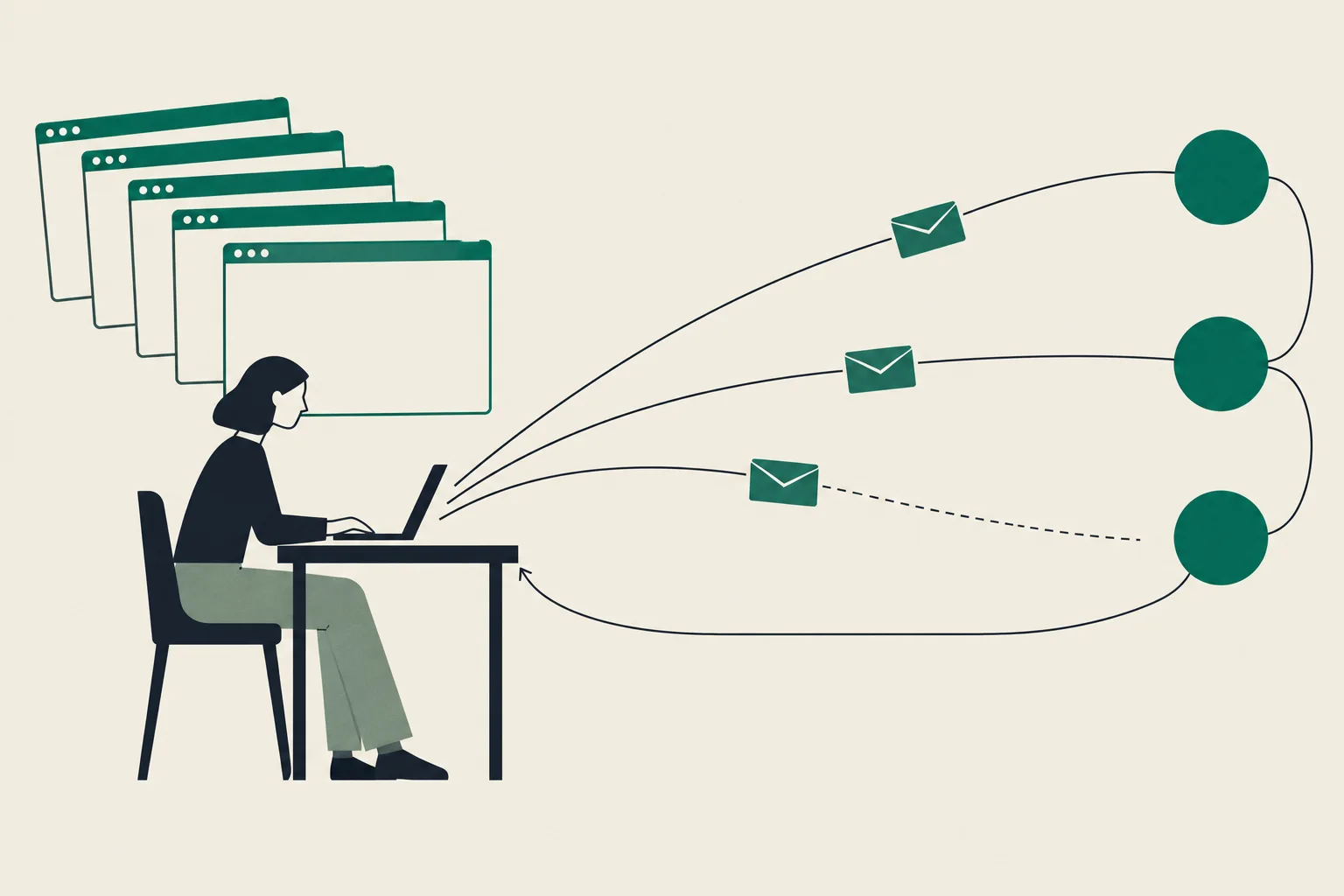
So you keep looking. Eventually you have three firms worth contacting, and you fill in one contact form, send one email and make one call.
Then you wait. A day later, one firm asks for photos and measurements, another wants to visit before quoting anything, and the third has not written back. You have spent an evening on research and you still do not have a single quote you can compare against another.
The internet made local businesses easy to find. It did not make them easy to hire.
That gap is the thing worth measuring, now that AI marketplaces are promising to close it.
Do people really open twenty websites?
Twenty tabs makes a good headline. The research says something less dramatic.
In June 2026 BrightLocal published the first part of its Consumer Search Behavior study, based on 1,227 US consumers who had searched for a local business in the previous three months.
75% said they had decided which local business to use in under 30 minutes, and more than a quarter decided in under five. The shortlist was small as well: 72% considered three businesses or fewer, and only 1% looked at more than ten.
People narrow down fast. They do not run exhaustive comparisons.
There is a catch in those numbers, though. The survey covers local services of every kind, restaurants and shops and clinics alongside tradespeople. Choosing a café is not choosing a contractor for a €20,000 renovation.
And it measures the choice, not the hire. It says nothing about how long it takes to get a written quote, arrange an inspection, or agree what the work actually includes.
A homeowner can pick three electricians in a quarter of an hour and then spend the following week trying to get usable prices out of them. The search is over. The hiring has barely started.
Few businesses considered does not mean few places visited.
A second BrightLocal study, from July 2026, found that 75% of respondents used more than one channel in their most recent local search. Google appeared somewhere in 71% of those journeys, alongside maps, social platforms, review sites and AI tools.
Finding information is not the same as confirming it. A business can show a strong rating on Maps and still send you to its website to find out what it actually does, then to a photo gallery to see whether the work looks like yours, then to a review site for a second opinion, then back to check whether it covers your commune.
Each of those is a different question. Is it near me? Does it do this kind of job? Can I trust it? Will it be free? Roughly what will it cost?
All reasonable questions. The trouble is that the answers live in five places, and when two of them disagree the customer is the one who has to decide which to believe.
The problem was never the length of the results page. It is having to assemble one coherent picture of a business out of fragments.
A quote needs the work described in enough detail to be priced. For a cleaning job that is floor area, frequency and a preferred slot. For a renovation it is measurements, photographs, materials, access, technical constraints and usually a site visit.
And if you want to compare, you write most of it again for each firm.
The repetitive part of asking for quotes: the same job, written out again for every firm on the shortlist.
This is the point where research turns into administration. The homeowner ends up collecting contact details, drafting descriptions, sending enquiries, tracking who answered, and working out whether the offers that come back even describe the same job.
Modernize's 2025 homeowner research found that roughly 41% of respondents planning a home-improvement project intended to compare two contractor quotes. That measures intention rather than how many quotes arrived, but it says something plain enough: people want a basis for comparison before they commit.
Getting it is the hard part.
In 2024 the messaging company Leadferno ran a field test on the contact forms of 225 small-business websites across home services, professional services and healthcare. Each enquiry was written to look like a real prospective customer asking for an appointment or an estimate.
42.6% of those enquiries got no response at all within the three-week observation window. Where a human did reply, the average wait for that first answer was about 17 hours and 49 minutes.
It was a US field test on a selected set of sites, not a representative national survey, and it should not be read as a national response rate. It still points at something no search engine can fix by ranking better: a customer can find the right business, send a perfectly sensible enquiry, and hear nothing.
The difficulty has moved from finding the business to reaching it.
The picture has to be assembled from several places
Shortlisting
72% considered three businesses or fewer
People narrow down quickly
Comparing
About 41% planned to compare two quotes
Choosing takes more than finding a good listing
Contacting
42.6% of tested enquiries got no reply
The process can break after contact is made
These come from separate studies with different populations and methods. They are not four stages of one measured funnel and they must not be multiplied together into a completion rate.
What they show between them is simpler. The journey is made of distinct tasks, and fixing one does not fix the next.
Better search results cut the effort of finding a suitable contractor. They do not make that contractor answer. A faster contact form makes the enquiry easier to send. It does not make the quote that comes back legible. And three prices are not three comparable offers.
The measure of a good platform is not how fast it shows you businesses. It is how far it gets you from a need to a decision you are comfortable making.
Comparing quotes is harder than getting them
Say the window project finally produces three offers: €9,800, €11,200 and €12,400.
The first looks like the cheap one. Unless it leaves out removing and disposing of the old frames. Or the second includes better glazing. Or the third carries a longer workmanship warranty and the finishing work around the openings.
Three quotes can add up to similar totals and still cover different work.
The three prices are not describing the same service, so the total is the last thing you should read. The scope comes first.
That is not just good practice, it is consumer protection advice. Luxembourg's Direction de la protection des consommateurs tells people hiring tradespeople to work from detailed written quotes and to check that the company is properly registered and holds a valid business permit. The European Consumer Centre in Luxembourg says the same about collecting several offers instead of accepting the first.
That advice holds however the contractor was found. A marketplace can make quotes easier to collect; it cannot make differences in materials, workmanship, exclusions and contract terms disappear.
What it can do is make those differences visible. Line the offers up in the same categories, work included, materials, exclusions, scheduling, warranty, total, and the comparison means something. Put three numbers side by side and it means almost nothing.
A directory is built to help you find businesses. An assistant can also help you turn a half-formed problem into an enquiry worth answering.
Take a customer who starts with this:
"We want to replace the windows in our house, but we're not sure what information installers need."
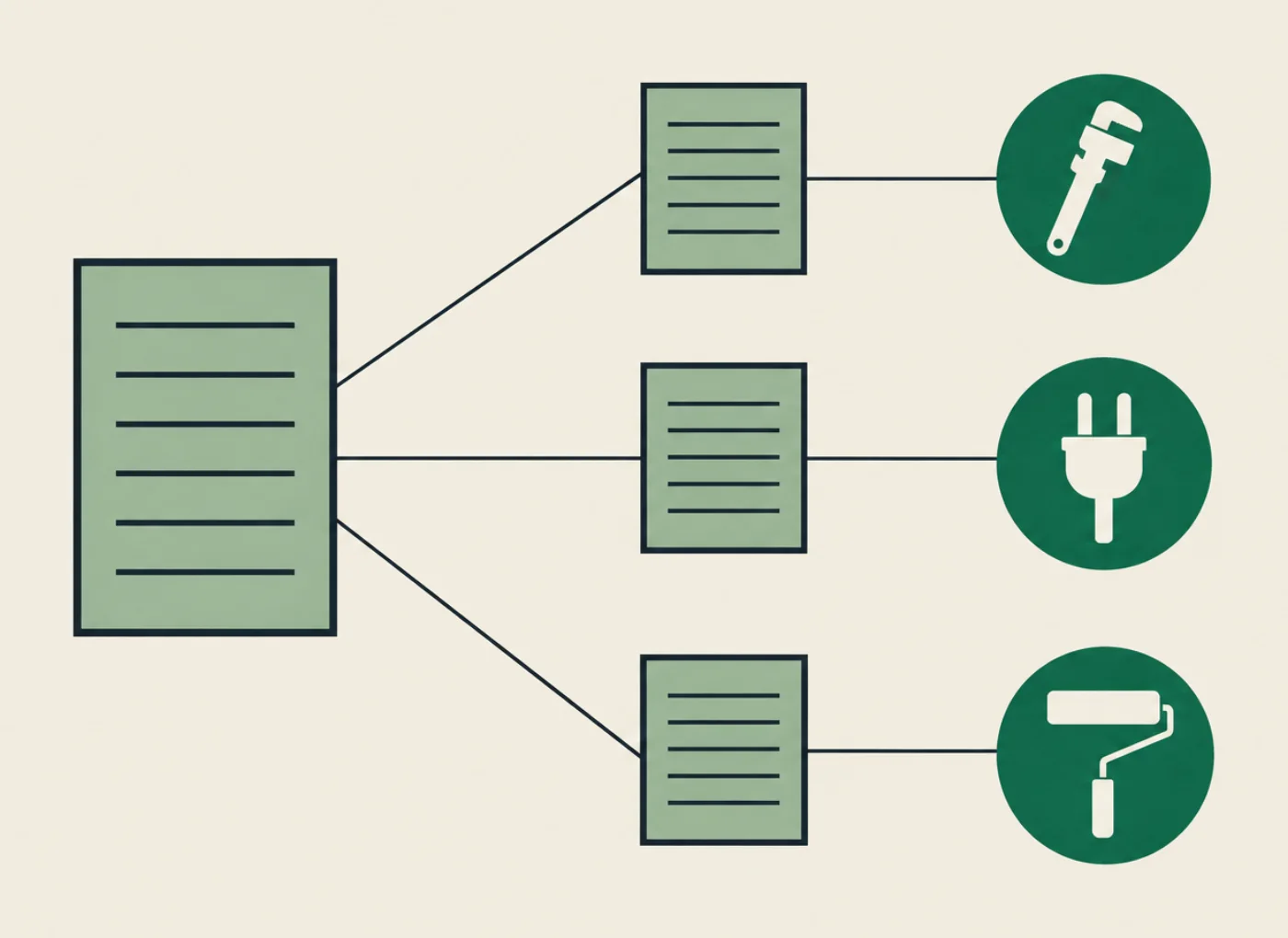
A conversational system can ask how many windows, what kind of building, whether the frames go too, whether there are photos or rough measurements. Instead of leaving the customer to work out how to write the enquiry, it builds the brief with them.
With the customer's permission, that brief then goes to the relevant firms. Written once, sent three times. That removes the most repetitive part of asking for quotes.
It can help earlier as well, if the marketplace holds reliable information about its providers. Rather than listing everything filed under "construction", it can show the firms that do this job, in this area, at this size.
And it can help afterwards, by organising what comes back and pointing at where the offers differ.
None of that replaces expertise. A model cannot establish the state of a building from a paragraph of text. It cannot promise a contractor is free unless something current tells it so. An automatically generated estimate is not a professional quotation, and presenting it as one does the customer no favours.
But it does not need to do any of that to be worth having. It only needs to remove the work that surrounds the job without being the job.
Thousands of very small firms
This matters more in Luxembourg than in a big market.
According to the Chambre des Métiers, there were 9,935 craft enterprises in Luxembourg in 2025, and about 81% of them employed fewer than ten people. The craft sector covers far more than building and home repair, but the figures show how much of the service economy sits with very small firms.
For those firms, answering enquiries is one job among many. A contractor may be on site, pricing another project, ordering materials and supervising a crew while a contact form fills up in the background.
For customers, finding a specialist does not reveal whether that specialist covers their commune, has room for another project this quarter, or works in a language they are comfortable with.
That last one is not a small detail here. Someone may want to describe a renovation in English to a firm that operates in French or German. An assistant can structure or translate the first message. The specifications and the contract terms still have to be checked by people.
The point is not to replace local expertise with software. It is to shorten the administrative distance between someone who needs work done and someone who can do it.
Rather than opening with a directory and leaving the rest to the customer, Fynd runs an AI assistant that helps describe the work in ordinary language. It asks clarifying questions, turns the answers into a project brief, and uses the service and the location to find relevant local providers. Replies and quotes come back in one place instead of across a scattered set of emails.
For the window job, the intended gain is modest and specific: describe it once, reach the firms that actually do it, keep the resulting conversations together.
Fynd also verifies the business registry entry of the providers on the platform. That is a floor, not a guarantee. Registration says a company legally exists; it says nothing about workmanship, insurance cover for your particular job, or whether anyone is free in March.
And none of the studies cited here measure Fynd's effect on search time, response rates or completed quotes. The honest claim is fewer repeated steps, not a specific number of hours saved.
That is also the standard any AI marketplace should be held to.
How much friction could actually come off
Deciding whether a new approach is better means more than counting clicks.
Picture a fair test. Two groups, comparable projects. One uses search engines, business websites and direct contact. The other uses an AI-assisted marketplace to prepare the request, find providers and organise the replies.
Then measure the same things in both. How long to prepare a complete enquiry? How many firms have to be examined to find three suitable ones? How often is the same project information entered again? How many enquiries get a substantive answer? And how long until two or three quotes arrive that can honestly be compared?
That last word is carrying weight. "We have received your enquiry" is not a reply. An AI estimate built from a general description is not a contractor's assessment. A test that counts both as success measures the wrong thing.
Shortlist quality belongs in the measurement too. Three irrelevant contractors in two minutes is worse than three suitable ones in ten.
As of today, the consumer studies above do not provide a controlled Luxembourg comparison between traditional search and an AI-assisted workflow. Somebody should run one.
Easier, without deciding for people
There is a trap in assuming the best experience is always the one with the fewest steps.
For something urgent or routine, speed is most of the value. Someone booking a cleaner or a maintenance visit wants the first available provider and nothing else.
For a major renovation, spending another evening on references, materials and contract terms is not friction. It is the job. A system that nudges people towards the first available firm would cut the browsing and worsen the decision.
Work on online choice architecture, including the UK Competition and Markets Authority's 2022 evidence review, shows how much the ordering and presentation of options shapes what people pick. A shortlist is not neutral because it arrived in a conversation.
So customers should be able to see why a business was recommended, and whether any commercial arrangement affects its visibility. They should be able to look past the shortlist and ask for more quotes.
Removing friction should never mean removing the choice. The useful version of this technology knows the difference between administration that can be automated and decisions that deserve the customer's attention.
Google, the neighbour's recommendation, review sites and company websites are going to stay part of how people find professionals. Nobody is going to let a stranger into their house or sign off on expensive work without wanting some reassurance first. Plenty of jobs will still need an inspection, a conversation and a carefully written quote.
But the number of tabs was never the right measure. What matters is how easily someone can identify the right firms, explain what they need, get real answers, and compare what comes back.
The research says the shortlist is the quick part. Getting from that shortlist to a decision you feel good about is where the time goes.
That is the part worth fixing, and not by handing customers a longer list.
Finding three contractors is easy enough. Getting three clear, comparable quotes from the right three is what moves the project forward.
Research note: the consumer behaviour and contact-form studies were run outside Luxembourg. Their findings come from different populations and methods and are not stages of a single funnel. No independently verified measurement of time saved by Fynd, or by any comparable Luxembourg marketplace, is presented here.