
Solar energy
Selling your solar electricity in Luxembourg: feed-in tariff, self-consumption and energy sharing
For systems ordered since March 2026, a home solar system gets the guaranteed feed-in tariff or the Klimabonus grant, and you pick one. What each route pays per kWh, how sharing with neighbours or an energy community adds to the second, and how to choose.
- 13,33 ct
- feed-in tariff per kWh, 2026, up to 10 kWp
- 5.742 €
- Klimabonus for a 6 kWp system
- 7,5–10 ct
- per kWh shared, published prices
- 26,65 ct
- average household price per kWh, 2025
TL;DR
- For systems ordered since 4 March 2026 you choose: the guaranteed feed-in tariff (13,33 cents per kWh for 15 years on a system up to 10 kWp) and no state grant, or the Klimabonus grant (5.742 € for 6 kWp, up to 10.000 €) and your surplus sold at market price.
- For most new home systems the grant wins. Self-consumed electricity saves far more than any price you get for selling it, and the grant is paid once, up front.
- Sharing comes on top of your route. You keep your buy-back contract: every quarter-hour your surplus goes to the sharing group first, at about 7,5 to 10 cents per kWh through the intermediaries that publish prices, and whatever is not shared goes to your supplier as before, at roughly 4 to 6 cents before fees.
- Sharing within your building or in a local energy community (same low-voltage grid, at most 300 m apart) carries no per-kWh grid fee. Sharing across the country keeps the grid fee of 5,1 cents per kWh, which is why it pays the producer less. The ILR’s new sharing rules were consulted on in autumn 2026 and are not adopted yet.
- No suitable roof? You can join a sharing group as a consumer and buy solar electricity from other members for less than from your supplier, with the same supplier and the same contract.
Current as of 4 November 2026.
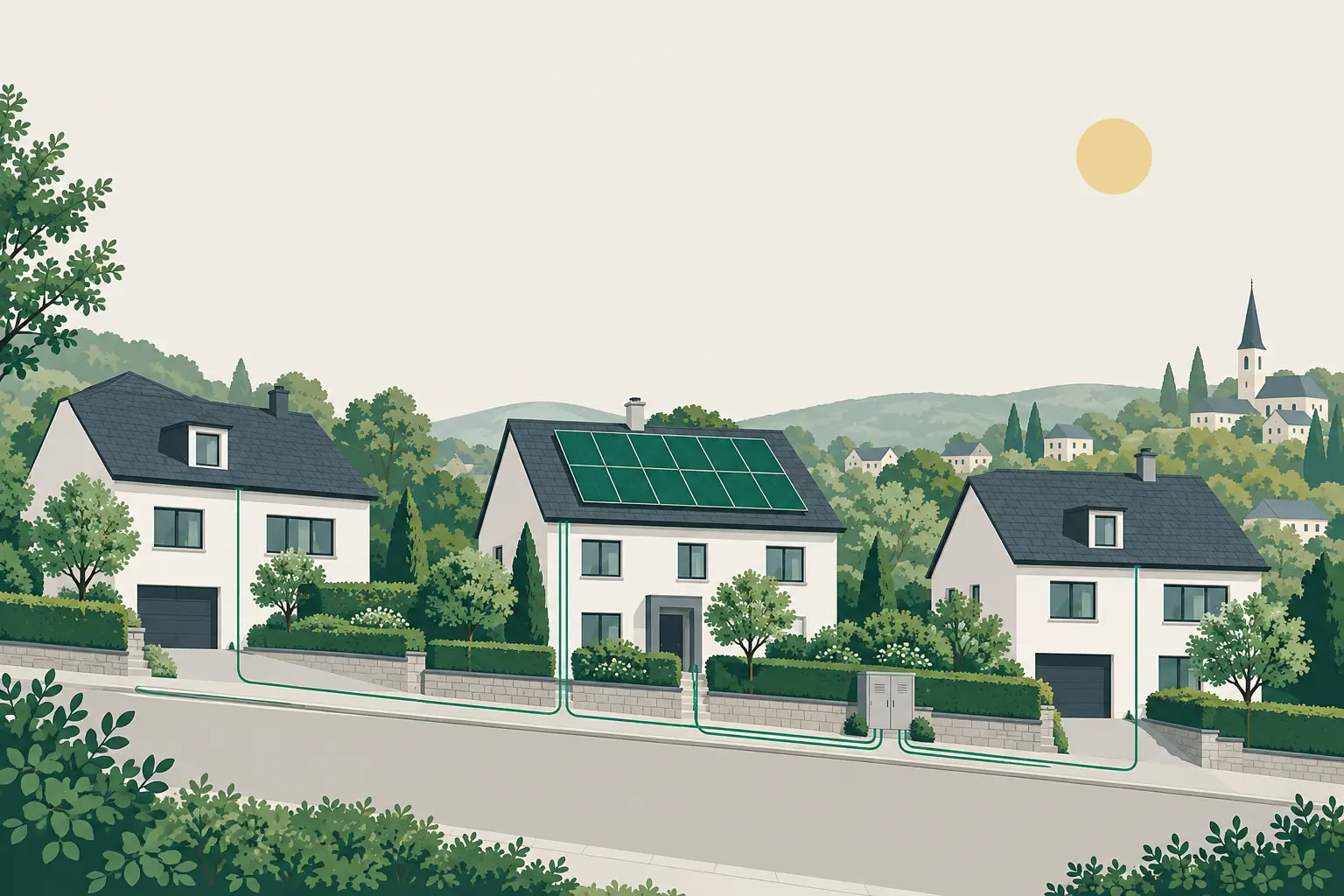
A house with a south-facing roof. The owners have a quote for 6 kWp of solar panels and one question the installer cannot answer for them: what happens to the electricity they do not use?
Until 2025 the usual answer was simple. Take the guaranteed feed-in tariff and a smaller grant. That answer changed in January 2026.
Today you choose between two routes and cannot have both. The guaranteed feed-in tariff, with no state grant. Or the Klimabonus grant, with your surplus sold at market price. Sharing your surplus with neighbours or an energy community comes on top of your route. You keep your contract, and on the grant route the kWh you share earn more than a supplier pays.
Two routes, plus sharing on top
| Route 1: feed-in tariff | Route 2: Klimabonus and market buy-back | On top: sharing | |
|---|---|---|---|
| What you get per kWh injected | 13,33 cents, fixed for 15 years (up to 10 kWp, first injection 2026) | A market price set by your supplier, about 4 to 6 cents in July and August 2026, before monthly fees | For the kWh your group takes: the group’s price, 7,5 to 10 cents through the intermediaries that publish prices. The rest is paid under your route’s contract |
| State grant | None for orders since 4 March 2026 | Klimabonus up to 10.000 €, plus up to 2.250 € for a battery | Unchanged: the grant follows your route |
| Who pays you | Your grid operator | Your electricity supplier | The other members, through the group or an intermediary |
| Main risk | Low: the rate is fixed | Market prices move every month | None on route 2 where there is no fixed fee. Founding your own group takes organisation, and a fixed monthly fee can exceed the gain |
| Suits | A large roof, little daytime use, a wish for certainty | Most households, especially with a heat pump or electric car | Anyone on route 2 with surplus to sell |
The rest of this article goes through each column, then compares them with real numbers.
Route 1: the guaranteed feed-in tariff
The feed-in tariff (tarif d’injection, Einspeisevergütung) is a fixed price per kWh you inject into the grid. It is set by grand-ducal regulation, guaranteed for 15 years from the date of first injection, and paid by your grid operator: Creos for most homes, or the City of Diekirch, the City of Ettelbruck or Sudstroum in Esch-sur-Alzette. You sign the contract with the grid operator before the installation is commissioned.
The rate is set by the size of the system and the year it first injects into the grid. Under the current rules it falls by 3% a year for systems up to 30 kWp, and it is not indexed to inflation once you have it.
| First injection | Up to 10 kWp | 10 to 30 kWp |
|---|---|---|
| 2025 | 13,74 cents | 12,91 cents |
| 2026 | 13,33 cents | 12,52 cents |
| 2027 | 12,93 cents | 12,15 cents |
Some websites still give 13,74 cents as the 2026 rate. That is the 2025 rate. Larger systems also get a guaranteed tariff, at lower rates: 10,14 cents for 30 to 100 kWp in 2026.
What changed in 2026. Under the new solar aid regime in force since 4 January 2026, a system on the guaranteed tariff gets no investment grant. Klima-Agence states that installations with a guaranteed feed-in tariff are no longer eligible for a subsidy. A transition period let installations ordered up to 4 March 2026 keep the old 20% grant (capped at 500 € per kWp) alongside the tariff, provided the final invoice is issued by 31 December 2026; orders in the same window that gave up the tariff could take the earlier 50% grant (capped at 1.250 € per kWp) on the same invoice deadline. For anything ordered after 4 March 2026, the tariff comes alone.
A tariff contract also needs an additional meter.
Sources: Klima-Agence, aid programmes and feed-in tariffs, Guichet.lu, feed-in contracts, Sudstroum and Klima-Agence, transition period
Route 2: self-consumption, the Klimabonus and a market buy-back
On this route you use as much of your own electricity as you can and sell the rest at market price.
The grant. The Klimabonus pays a one-off amount that depends on the system’s peak power P, in kWp: P × (1.155 − 1.155/35 × P) euros below 15 kWp, and a flat 10.000 € from 15 kWp. The formula gives more per kWp to smaller systems. The system needs at least 2 kWp, mounted on the roof or façade, built into the building, or on a carport, garden shed or other construction on the same plot.
- Bought from the grid, 202526,65 ct
- Feed-in tariff, 202613,33 ct
- Shared within 300 m10,00 ct
- Shared nationally7,50 ct
- Sold to a supplier5,00 ct
Cents per kWh. Bought from the grid: ILR average price paid by a typical household in 2025, all included; a kWh you use yourself saves somewhat less, because fixed meter and network charges stay the same. Feed-in tariff: Klima-Agence table, first injection in 2026, up to 10 kWp. Shared: WattSwap’s published producer prices after its commission, November 2026. Sold to a supplier: 0,8 to 0,9 × the German monthly solar market value, which was 5,2 to 6,4 cents in July and August 2026, before any monthly fee.
The condition is that the system runs in self-consumption mode and that you expressly give up any regulated payment for the electricity you inject, for the whole life of the installation. The waiver stays with the installation, including when the house is sold. You may still inject your surplus and sell it at market price.
Getting the money. Since 4 January 2026, an installer on the official register can deduct the grant directly from your final invoice (prefinancing). The deposit you pay before the final invoice may not exceed 30% of the total. Otherwise you pay in full and apply yourself after installation. From 1 January 2027, prefinancing moves into the Klimabonus 2026 scheme under the law of 24 July 2026. Guichet.lu currently gives orders up to 31 December 2029 and applications by 31 December 2031. Every amount and condition is on our page on solar panel subsidies, and the order of steps across several projects is in Renovation aid in the right order.
A battery is aided separately: up to 2.250 € from 9 kWh of usable capacity, about 1.806 € for 5 kWh. An energy management system that controls at least two devices, such as the heat pump and the car charger, gets 500 € if invoiced from 1 October 2026.
Selling the surplus. You sign a buy-back contract (contrat de rachat, Abnahmevertrag) with a supplier of your choice. On this route there is no official price for your surplus. The common offers follow a German market index for solar power (MW Solar) each month:
- Enovos pays 0,8 × that index and deducts a fee of 5 € a month for systems up to 30 kWp.
- Nordenergie and Steinergy pay 0,8 × the index.
- Sudstroum pays 0,9 × the index if it also supplies your main meter, 0,8 × otherwise, for systems under 30 kWp.
- Sudenergie pays 0,82 × the index and charges 4,50 € a month whatever you sell, for systems up to 30 kWp.
The index was 5,2 cents in July 2026, 6,4 cents in August and 8,2 cents in September, but only 1,3 cents in April. In July and August these offers paid roughly 4 to 6 cents per kWh before monthly fees. A fixed monthly fee weighs heavily on a small surplus: 300 kWh sold to Enovos in July 2026 earned 12,54 €, or 7,54 € after the fee. Dynamic offers follow the wholesale price every quarter-hour and pass on negative prices: when it is below zero, injecting costs you money.
Why self-consumption matters most. In 2025 a typical household in Luxembourg paid 26,65 cents per kWh on average, with network charges, taxes and VAT included and state aid deducted, according to the regulator ILR. A kWh you use yourself saves the per-kWh part of that bill: somewhat less than 26,65 cents, because the fixed meter and network charges stay the same, but still several times what selling pays. Every kWh you sell earns about 4 to 13 cents. A heat pump, an electric car charged at midday or a battery moves more of your production into the first category. If you are weighing a heat pump anyway, see Heat pump or new boiler.
Sources: Guichet.lu, Klimabonus 2026 technical installations, Guichet.lu, prefinancing, Enovos MW solar, Sudstroum and ILR key figures 2025
Grant or tariff: the numbers for a 6 kWp house
Take the house from the start. A 6 kWp system gets a Klimabonus of 6 × (1.155 − 33 × 6) = 5.742 €, paid once.
On the grant route you still sell your surplus. So the question is whether the tariff’s extra over that sale makes up the 5.742 € within 15 years.
| If your surplus would otherwise earn | The tariff earns more by | kWh to inject over 15 years to match the grant | Per year |
|---|---|---|---|
| Nothing | 13,33 cents | about 43.100 | about 2.870 |
| A supplier buy-back, 5 cents | 8,33 cents | about 68.900 | about 4.600 |
| Half shared at 10 cents, half sold at 5 cents: 7,5 cents on average | 5,83 cents | about 98.500 | about 6.570 |
A 6 kWp system would have to inject about 4.600 kWh every year for 15 years just to draw level with a market buy-back, and the grant arrives on day one while the tariff arrives over 15 years. Sharing raises that bar to about 6.570 kWh a year. The third row uses a mixed price because only part of a surplus is ever shared: on a sunny midday a group has more producers than consumers, WattSwap notes, and the kWh that find no taker are sold to the supplier. Half and half is an illustration; your own split depends on the group. Every kWh you use yourself also reduces what you inject, which weakens the tariff case further.
The tariff can still make sense for a large roof on a home that uses little electricity during the day. Check your roof’s likely production with the solar cadastre or Klima-Agence’s simulator before you decide; this example shows the method, and your roof’s production will differ. For installation prices, see what solar panels cost in Luxembourg.
On top of your route: sharing your surplus
Sharing is added to the contract you already have. You keep your buy-back contract and cancel nothing. Every quarter-hour your surplus goes to the group first, and whatever the group does not take goes to your supplier as before.
A law of 3 February 2021 first allowed households to share electricity, within one building or in a renewable energy community in the same locality. A law of 9 June 2023 extended this to neighbours within 100 m and to energy communities across the country, and a law of 2 April 2026 added sharing between active customers anywhere in the country. Every member keeps their own supplier for whatever the group does not cover, and nobody has to change contract to join.
- Your own homeAppliances, heat pump, car charger, battery. Every kWh used here is one you do not buy from the grid.
- Your sharing groupNeighbours, family or an energy community you have joined. The group sets the price, and fees depend on distance.
- The gridWhatever is left is injected and paid under your contract: the guaranteed tariff, or a supplier’s market price.
Each step only receives what the step before it could not use. The grid operator settles this every quarter-hour from your smart meter.
How it works
Your smart meter already records what you inject and what you draw. Every quarter-hour, the grid operator assigns the surplus of the group’s producers to its consumers, using the allocation key the group chose: in order of priority, by fixed percentage, or in proportion to what each member is consuming at that moment, which is the default. The data is available on LENEDA, the national energy data platform run by Creos.
Members pay for shared electricity among themselves, or through an intermediary that collects and pays out for them. The price is whatever the group agrees, and sharing can also be free.
Only part of your surplus is shared. A kWh counts as shared when another member uses it in the same quarter-hour. On a sunny midday a group has more producers than consumers, so some of the surplus finds no taker and is sold under your contract as before.
The types of sharing group
The regulator ILR and its information site weshareenergy.lu describe three ways to share: collective self-consumption (AC), sharing between active customers (CA) and the energy community (CE), which is either local (CE-L) or national (CE-N).
| Type | Who can share | Legal entity | Per-kWh grid fee on shared kWh |
|---|---|---|---|
| Collective self-consumption (AC) | Users in the same building, or up to 3 users on the same low-voltage grid within 100 m | No | None |
| Local energy community (CE-L) | Members within 300 m on the same low-voltage grid | Yes, usually an asbl or cooperative | None |
| National energy community (CE-N) | Members anywhere in the country | Yes | 5,1 cents in 2026 |
| Sharing between active customers (CA) | Anyone, anywhere in the country, for example family in another town | No | 5,1 cents in 2026 |
The last type is new with the 2026 law: you can share with someone across the country under a private agreement, without founding an association. The law is in force, but the grid operators’ standard agreement for it is still out for consultation, so check with your grid operator that it is available before you plan on it. A meter can belong to at most one building or 100 m group, one local community, and one national group (a CA or a CE-N), and sharing happens nearest first: the building or 100 m group, then the local community, then the national group, then the grid.
Sharing only covers renewable electricity, and one sharing project is capped at 6 MW of installed capacity in total.
The grid fee decides what sharing pays. For every kWh you draw from the grid, your supplier bills a grid fee on your electricity bill on behalf of the grid operator: 5,1 cents per kWh in 2026 for a standard low-voltage connection. In a building group or a local energy community (all members on the same low-voltage grid, at most 300 m apart), shared renewable kWh carry no such fee. In a national community or between active customers the fee stays, even if the members live next door. That leaves less to split between the two sides, which is why a producer receives less for national sharing than for local sharing. Members still pay the fixed and capacity parts of their own grid bill. In every type, shared kWh from installations up to 100 kW carry no electricity tax.
What it pays
There is no official sharing price: each group sets its own. Three offers published in November 2026 differ mainly in who you share with and who builds the group.
- Enovos’s Energy Sharing Service manages a group of your own. You found it yourself and find the members (neighbours, family, friends), or you join a group someone else has founded. Enovos then handles the administration and the billing, and you share only with the people in that one group. The group sets its own price; Enovos charges 1,5 cents per shared kWh at each participating meter, producer and consumer alike, excluding VAT, with no fixed monthly fee.
- WattSwap runs one community for the whole country, with around 3.000 members by its own count. You sign up online and do not have to find anyone to share with. WattSwap handles the registration with the grid operator, the administration and the billing, and you share automatically with neighbours within about 300 m and with every member in the country. Its commission is also 1,5 cents per kWh on each side, already included in its prices.
- The City of Differdange’s e-community, organised as a cooperative, is a ready-made community too, open to residents of the commune only. It pays producers a guaranteed 7,5 cents per kWh. The City does not publish the fees; ask before you sign.
With Enovos you bring your own group. With WattSwap you join an existing nationwide one.
Against a supplier buy-back at 4 to 6 cents before fees, sharing pays the producer roughly 1,5 to 6 cents more per kWh, on the part of the surplus that finds a taker in the same quarter-hour. The rest is sold under your contract as before, so a producer on a buy-back contract cannot lose by adding a scheme that charges no fixed fee.
Watch for fixed fees. A scheme that charges a monthly amount per meter can cost more than it earns in a poor year or for a small surplus. Ask for the full fee schedule before you join.
How WattSwap works
WattSwap describes itself as Luxembourg’s largest energy-sharing network: around 3.000 households and businesses across the country that share solar electricity with each other. You do not need to found a group or find anyone to share with. You sign up online and WattSwap adds you to its network. It runs the community for you: the administrative work, the growth and management of the network, the payments between members, and a customer portal that shows your own production and consumption.
Each member is placed in a local group and in the national community where possible. Sharing happens locally first. Until neighbours have joined, everything is shared nationally.
A supplier pays roughly 4 to 6 cents for a kWh of solar surplus and charges about 20 cents for a kWh delivered, grid fee included, on the reference figure of WattSwap’s price page. WattSwap connects the two sides directly and splits the difference between them.
| Per shared kWh | Through a supplier | WattSwap, neighbours within about 300 m | WattSwap, rest of the country |
|---|---|---|---|
| Producer receives | about 4 to 6 cents, before fees | 10 cents | 7,5 cents |
| Consumer pays, grid fee included | about 20 cents | 13 cents | 15,6 cents |
WattSwap’s commission of 1,5 cents per side is already included. National sharing pays less because the consumer still owes the grid fee of 5,1 cents to their own supplier.
Nothing else changes. You keep your supplier and your contract. WattSwap bills only the kWh actually shared, and those kWh drop off your supplier’s bill. Everything that is not shared runs through your supplier as before. There is no fixed fee, so no month of membership costs you money, and you can leave at any time with 30 days’ notice.
Does sharing work with the feed-in tariff and the Klimabonus?
With the Klimabonus: yes. Guichet.lu describes the solar grant as covering installations "in self-consumption mode or as part of an energy community", and the application form has one box for both.
With the feed-in tariff: yes, and the shared kWh then earn the sharing price in place of the tariff. Klima-Agence says that an installation still on the guaranteed tariff can join collective self-consumption or an energy community and the conditions of the tariff do not change. The tariff is paid on the kWh that still go to the grid. For the kWh the group takes, you receive the group’s price and no tariff. At the published sharing prices of 7,5 to 10 cents, that is less than the 2026 tariff of 13,33 cents. Whether the new active-customer sharing accepts tariff installations on the same terms is not yet stated in an official source.
If you are on an older tariff contract, you can start self-consuming or sharing and keep the tariff on the kWh that still go to the grid. If the installation was aided under the earlier scheme, it cannot get a Klimabonus 2026 grant as well. A battery added later can qualify for the battery grant under conditions: the solar system must run in self-consumption mode, the battery must have at least 2 kWh, and you apply after the work rather than through prefinancing. No official source says whether this works for a system still on the guaranteed tariff; ask Klima-Agence before you buy.
How to join or start a group
- Join an existing scheme. Through an intermediary, through your commune if it runs one, or by asking Creos ([email protected]) which group suits you. The ILR’s list of 2 November 2026 has 145 entries, up from 64 on 1 October 2025; 24 of them are communes.
- Share with up to two neighbours within 100 m on the same low-voltage grid, or within your building. No legal entity: all members sign the standard agreement with the grid operator (through myCreos if it is Creos) and name a representative.
- Start an energy community. Gather the members, including at least one producer. Choose an allocation key. Create an asbl or cooperative. Notify the ILR online; the entity must exist first. Sign the standard sharing agreement with the grid operator. Make sure whatever is left over is covered by a buy-back contract or an existing feed-in contract. Agree among members how shared electricity is paid. Changes have to be notified to the grid operator at least a month ahead.
Before you commit, the ILR’s We Share Energy software, free to download on weshareenergy.lu, simulates how a group would split electricity using members’ own meter data from LENEDA.
The rules are being updated. The ILR consulted from 14 August to 27 September 2026 on a new allocation model and standard contracts, including sharing between active customers and batteries in energy communities. As of early November 2026 the final regulation has not been adopted, so the February 2024 rules and standard agreements still apply. Check the ILR’s site for the current version before you sign.
Sources: weshareenergy.lu, sharing groups, ILR consultation, ILR list of energy communities, Klima-Agence, energy communities, Creos, ILR grid tariffs 2026, WattSwap prices, WattSwap FAQ, Differdange and Enovos energy sharing
Tax: what a household has to declare
Income tax. For an individual with a system of 1 to 30 kWp, the tax administration accepts, as an administrative tolerance, that producing electricity is in general an amateur activity. You do not declare the income or the expenses, and this also covers surplus sold to another person or to an energy community. Above 30 kWp the tolerance does not apply and the case is examined individually.
VAT on the purchase. Solar panels supplied and installed on or right next to a private home are taxed at 3% instead of 17%; panels bought on their own, for example to fit yourself, are not. Batteries are not covered and are taxed at the normal rate.
VAT on sales. Selling electricity technically makes you liable for VAT. With annual turnover of no more than 50.000 € (since 1 January 2025; it was 35.000 € before) you can use the small-business franchise: you register with the Administration de l’enregistrement (AED), file no VAT returns and charge no VAT, cannot recover VAT on your purchases, and report the previous year’s turnover to the AED before 1 March. Check the current practice with the AED.
Sources: circular L.I.R. n° 14/2, AED franchise FAQ and Klima-Agence, tax treatment
No suitable roof? Buy shared solar instead
Sharing has two sides. For every household selling surplus, someone has to use it in the same quarter-hour. If your roof faces north, you live in a flat or the numbers above do not work for you, you can join a sharing group as a consumer.
You keep your supplier and your contract. Whenever members of the group produce more than they use, part of your consumption is covered by their electricity at the group’s price, and your supplier bills the rest as usual. Through WattSwap, that price is 13 cents per kWh all in from neighbours within about 300 m, and 10,5 cents plus the grid fee of 5,1 cents from members elsewhere in the country, against about 20 cents per kWh from a supplier including the grid fee, on WattSwap’s reference figure. There is no fixed fee, so months with little sun cost nothing.
The more you use around midday, the more you save: a car charged at lunchtime, a heat pump in spring and autumn, a home office. The same applies to small businesses that are open during the day.
How to do it, in order
1. Start with free advice
Klima-Agence gives free, independent advice on 8002 11 90, and its simulator at aides.klima-agence.lu shows which aid you qualify for.
2. Decide the route before you sign
Tariff or grant: you cannot switch to the tariff later once you have waived it. If you take the grant, decide on prefinancing and keep the deposit at 30% or less.
3. Choose a registered installer
For prefinancing, the installer has to be on the official register. Ask for a quote that states the order date and the peak power in kWp.
4. Register with the grid operator
Your installer or you apply for the connection and self-consumption with your grid operator; with Creos, through myCreos.
5. Sign a contract for the surplus
A buy-back contract with a supplier, or the feed-in contract with the grid operator if you took the tariff.
6. Add sharing
Join an existing network or start a group, and keep your buy-back contract for whatever the group does not take. Where there is no fixed fee, a producer on the grant route has nothing to lose. Where a scheme charges a monthly fee, check that your surplus covers it.
7. Claim what is left
If the installer did not prefinance the grant, apply through MyGuichet.lu or on paper, with the paid invoices, proof of payment, the installer’s technical sheet and the other documents Guichet.lu lists.
The dates that matter
| Date | What it decides |
|---|---|
| 4 January 2026 | New solar aid regime and prefinancing start; a tariff now means no grant |
| 4 March 2026 | Last order date for the old 20% grant with the tariff, invoiced by 31 December 2026 |
| 1 January 2027 | Solar and battery aid and prefinancing move into the Klimabonus 2026 law; for systems first injecting from this date, the feed-in tariff falls to 12,93 cents up to 10 kWp and 12,15 cents for 10 to 30 kWp |
| 31 December 2029 | Last order date for the current solar grant, according to Guichet.lu |
| 31 December 2031 | Last date to apply for it |
What the numbers show
The numbers in this article compare routes under stated assumptions. What a real roof earns depends on its orientation, your consumption, the market price month by month and the group you join.
The money sits first in the electricity you use yourself, then in the grant, then in selling the rest at the best price you can find. For the part of your surplus that finds a taker, sharing is now often that best price.
Use as much of your solar electricity as you can, take the grant, and add sharing on top for what is left.
Legal note: this reflects the official guidance available on 4 November 2026. For solar and batteries, the law of 24 July 2026 applies from 1 January 2027; invoices in 2026 fall under the earlier Klimabonus law and the prefinancing law of 19 December 2025, and the official sources do not give identical end dates. The ILR’s new sharing regulation is pending. Sharing prices and member numbers are the companies’ own figures. Confirm your case with Klima-Agence (8002 11 90) or the Guichet unique des aides au logement (8002 10 10) before signing.
Sources
- Klima-Agence — Aid programmes, including the feed-in tariff table for 2025 to 2027
- Guichet.lu — Producing electricity from renewable sources (feed-in contracts)
- Guichet.lu — Klimabonus 2026: heat pumps, solar panels and batteries
- Guichet.lu — Prefinancing of solar installations
- Klima-Agence — Understanding the Klimabonus transition period for solar, 17 December 2025
- Administration de l’environnement — Solar installations FAQ, including the transition period
- Government of Luxembourg — New solar aid regime with prefinancing, 9 January 2026
- Law of 24 July 2026 on the Klimabonus Wunnen aid scheme (Legilux)
- Klima-Agence — Collective self-consumption
- Klima-Agence — Energy communities
- weshareenergy.lu (ILR) — Sharing groups: AC, CA and CE
- weshareenergy.lu (ILR) — Allocation keys
- ILR — Public consultation on the sharing model, 14 August to 27 September 2026
- Law of 2 April 2026 amending the electricity market law, energy sharing (Legilux)
- ILR — List of energy communities, 2 November 2026 (PDF)
- ILR — Key electricity figures 2025, press release of 30 June 2026 (PDF)
- ILR — Grid tariff sheet of the distribution system operators for 2026 (PDF)
- Creos — I share my energy
- Sudstroum — Electricity production and buy-back
- Enovos — MW solar buy-back
- Enovos — MW solar price sheet, including the monthly fee (PDF)
- Nordenergie — MW solar buy-back
- Sudenergie — MW solar buy-back
- Netztransparenz — Monthly market values for solar power (MW Solar)
- Enovos — Energy sharing service
- WattSwap — Prices
- WattSwap — General terms
- WattSwap — Frequently asked questions
- Ville de Differdange — Join Differdange’s e-community
- Administration des contributions directes — Circular L.I.R. n° 14/2 of 5 June 2023 (PDF)
- Administration de l’enregistrement — VAT franchise for small businesses, FAQ (PDF)
- Klima-Agence — Tax treatment of a home solar installation, September 2025 (PDF)